
Somewhere in the depths of the closet in my home office — among the baseballs and bobbleheads, the old books and outdated media guides, behind a bunch of untouched DVDs and about a thousand plastic cups from various sporting events — is a professional-grade, lightly used single lens reflex Nikon camera that I bought at an unbelievably good deal at Costco maybe 15 years ago. It’s a sweet piece of equipment, weighty and no-nonsense, in a camera bag filled with (as I recall) a couple original Nikon lenses and a trove of other photographic accompaniment: straps, lens caps, lens cloths, lens cleaner. Might be a light meter in there. A few memory cards, I’m sure.
Years ago, a setup like that was an amateur photog’s absolute pride. It was proof that you were serious about photography, dedicated to it. With gear like that, you might not be a full-fledged artist. But you were pointing that way.
And yet, now, the carefully crafted glass of the lenses, the polished mirrors and intricate mechanics of the camera itself, the bag with its purposeful compartments and the cool accessories all sit nearly forgotten in the back of that closet with no light. Unused for years and likely to stay that way.
Because … phones.
We are just back from another vacation, the family is, one that promised (and delivered) fantastic scenery, landscapes quite literally worthy of an Ansel Adams photograph, and memories that demanded preserving. Yet I was on the plane heading West before I even thought about bringing my professional camera gear.
—**—
Photography is hard. It’s hard to get right. It’s hard to get right consistently. It’s especially hard when, in order to get it right, you have to tote 10 tons of gear along with you. I found that out a vacation or two after buying the rig at Costco and humping it through Yosemite, or Hawaii, or Acadia, or wherever we were. It’s much easier to point, shoot, put your phone back in your pocket and go. People found that out early. Which, it occurs to me now, is probably why Nikon was unloading all those cameras at such a great discount at Costco.
As everyone knows, these pocket cameras have only improved over the years, too. Now you can shoot photos (and video) at night. You can edit, right there on the phone. You can make them sharper, play with the contrast, up the saturation (as if I really know what that means), put a little vignette on them. You can crop them, you can wipe out annoying clutter in the background, and (in an improvement even on my forgotten digital SLR), you can shoot and shoot and shoot until the bison come home. You don’t end up with art, necessarily. But it’s way better than what came out of that roll of 36-exposure 35mm film that your folks took on the family beach vacation.
—**—
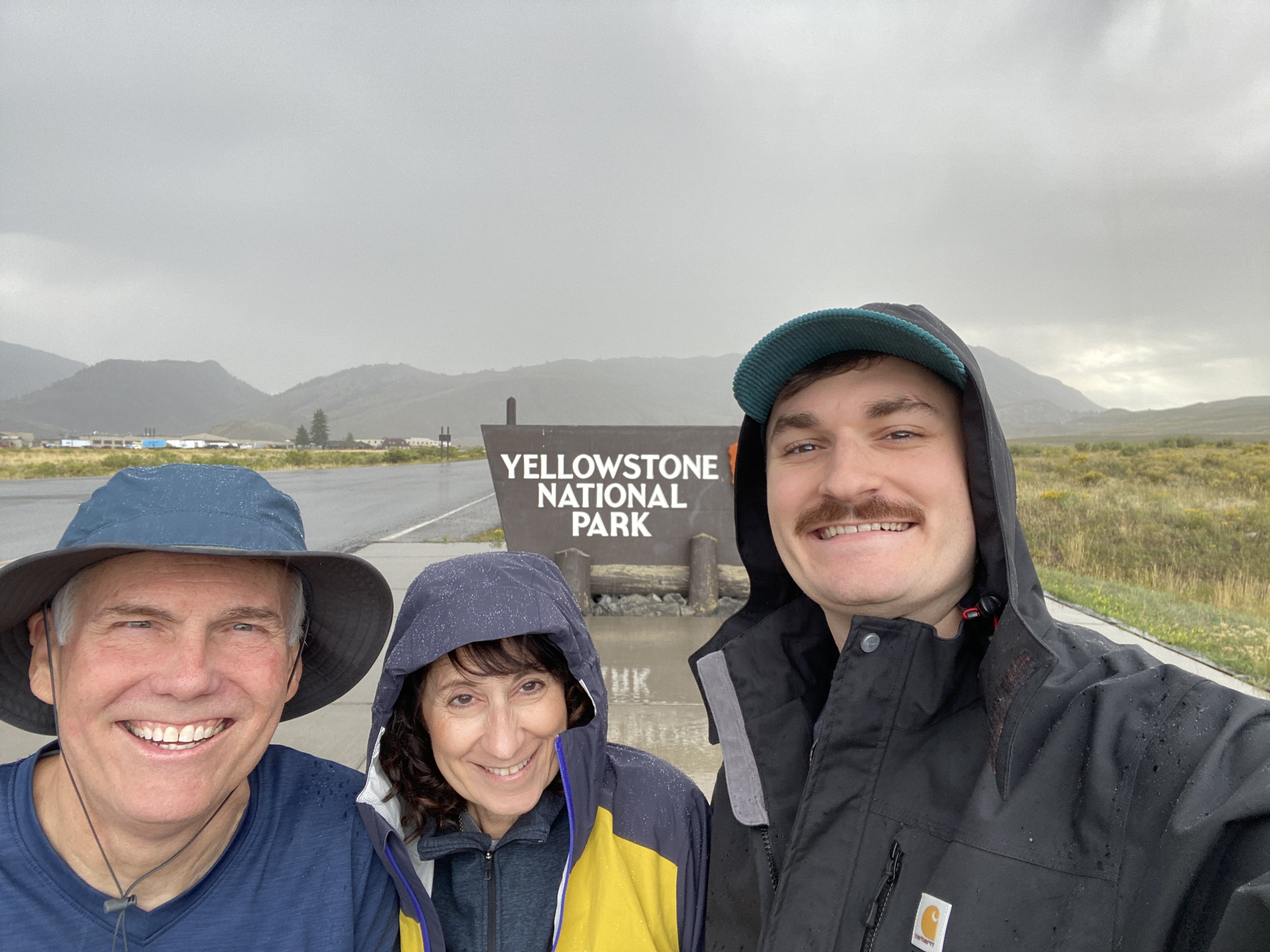
We went to Yellowstone National Park last month. Luke flew in from San Diego. Mary Jo and I met him in Bozeman, Montana. This was a year-delayed trip, one postponed when floods wiped out some roads in the northern part of the 3,400-square mile park in the spring of ’22. (We did a quick trip to New Mexico and White Sands instead last year.)
I’ve done a few posts like this over the years in JD Blogs, rhapsodizing over the National Park System. Few things that the federal government has done, ever — I know, it’s a short list — have gone as well as this national parks idea.
Over the years, these posts have been, as you might expect, full of photos. This post will be, too.
But while I’m at it, let me give you a half-dozen other snapshots, of a kind.
—**—
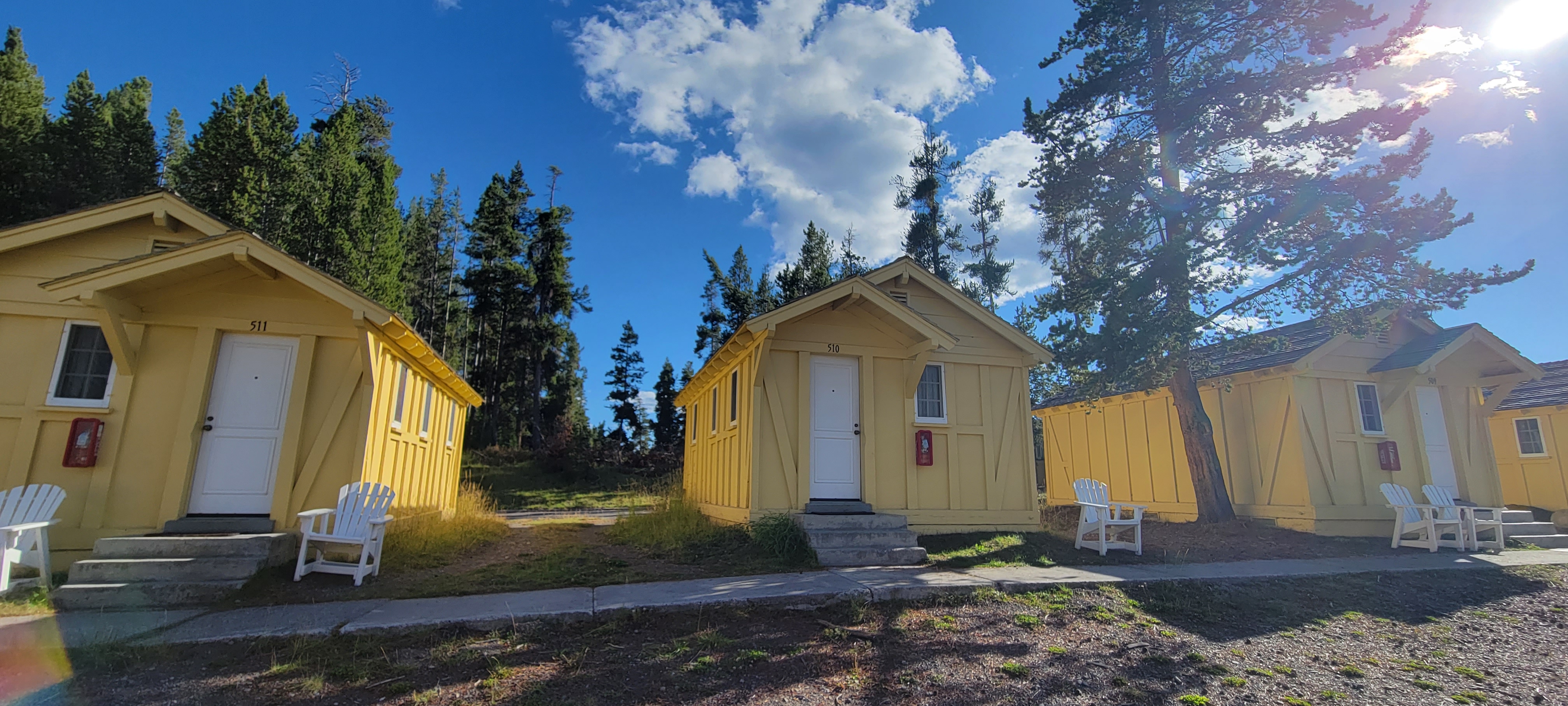
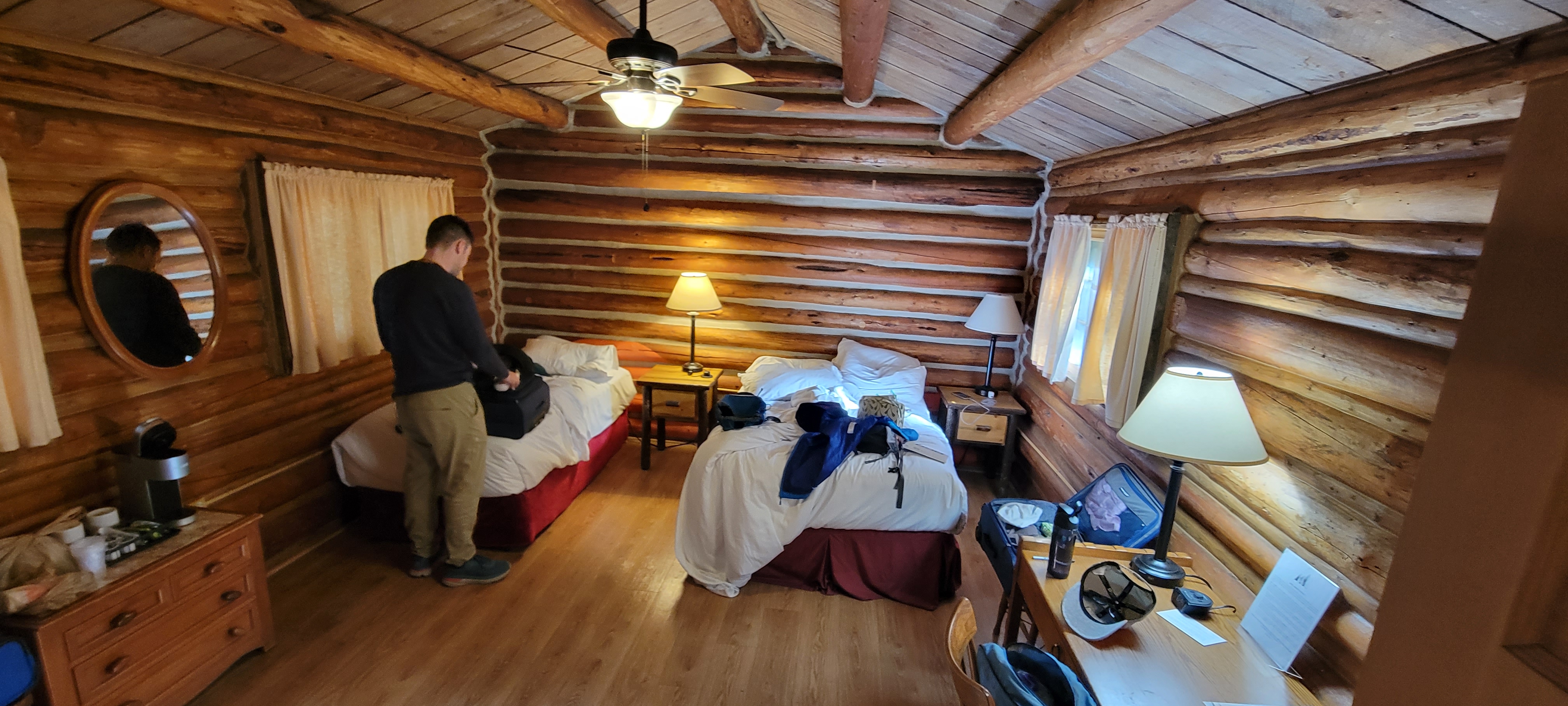
We were sleeping in our little cabin* in the middle of Yellowstone after a long day of hiking and awe-ing and searching for something decent to eat. (* A picture of the cabin, as with everything marked with an asterisk, is in the slideshow below.) It was late. It was dark. The cabin was cold. Someone, probably me, may have been snoring.
Someone — this definitely was me — was awakened. Shaken from an unsilent slumber. Not by a scream of some stupid tourist who had poked a bear or a howl from a wolf in the nearby woods. Not by the shuddering of the single wall heater in the old, drafty cabin (it’s described as “rustic”), but by the quiet and somewhat guilty laughter of my wife, beside me, climbing into bed.
“I got lost,” she whispered.
This standalone cabin was the size of a small, I-95 motel room. It had two twin-ish beds a foot apart, a sink, a small shower, and a toilet. It had a desk crammed in by the foot of the beds. It had the cranky heater. To get “lost” in that space took some imagination.
But there was Mary Jo, padding around in the middle of the night after a frigid couple steps to the bathroom, feeling her way along the bed, reaching out to find her bearings in a darkness that you just don’t get in the suburbs, only to stir the only other creatures in the place. Well, the only humans, anyway.
Luke was not, at the time, happy about being patted down in the middle of the night. Luckily, by the next morning, all he could remember was some dream about being stopped by the police.
—**—
National parks are not known for their great food. Or, for that matter, good food. And, surely, don’t expect fancy. Don’t expect Chick-fil-A. (An exception: A fine burger last year in Bandelier National Monument in New Mexico.)
There are restaurants to be found in Yellowstone, but for the most part they’re big cafeteria-type things aimed at getting tourists and families fed as quickly as possible. Think more Six Flags than Four Seasons. And after a bison dog on the first day in Yellowstone, and a bison burger the next, both with the requisite fries … well, that was plenty of that.
Everybody stocks up on sandwiches and snacks from the half-dozen or so general stores around the park for their walkabouts. But, again, this isn’t cloth napkins and a friendly waiter stuff. Roughing it, you know? Rustic.
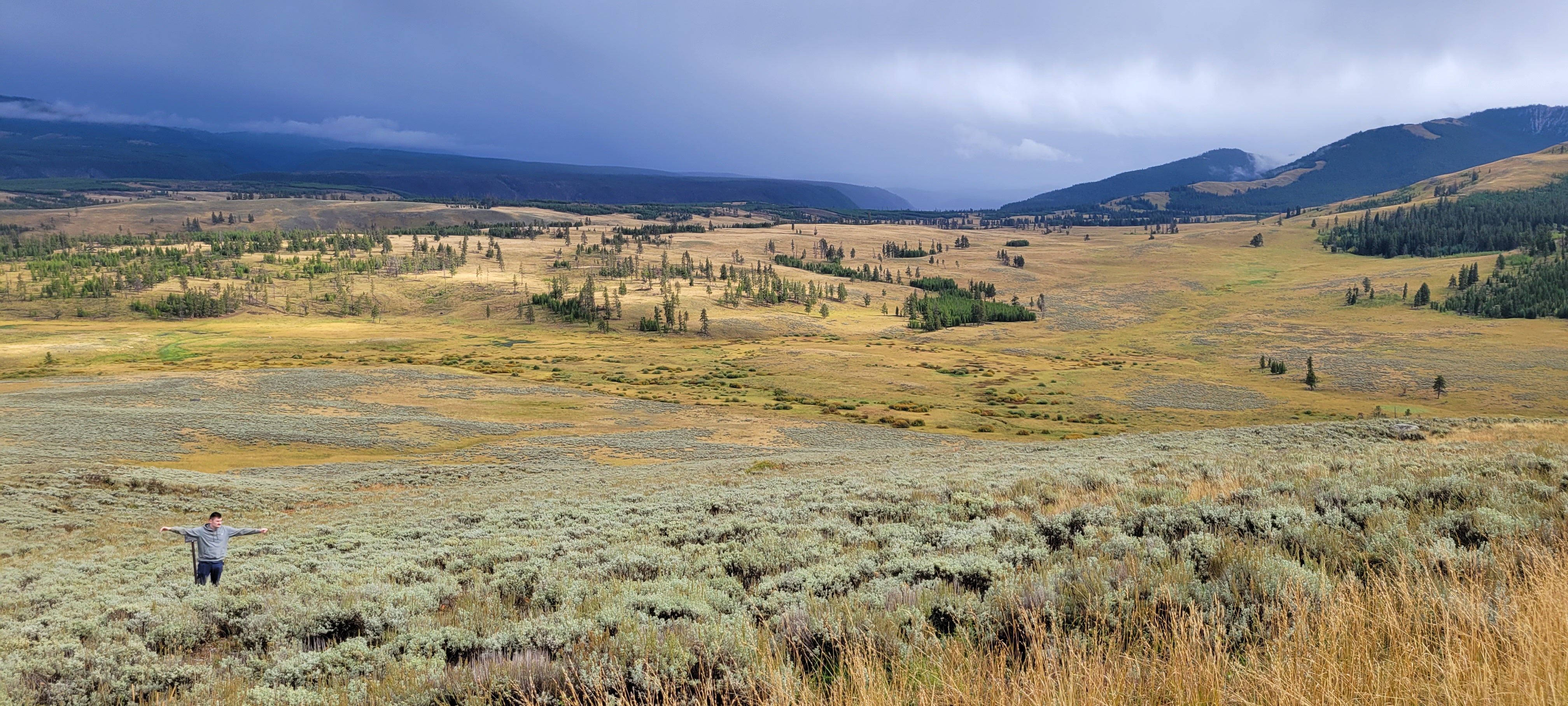
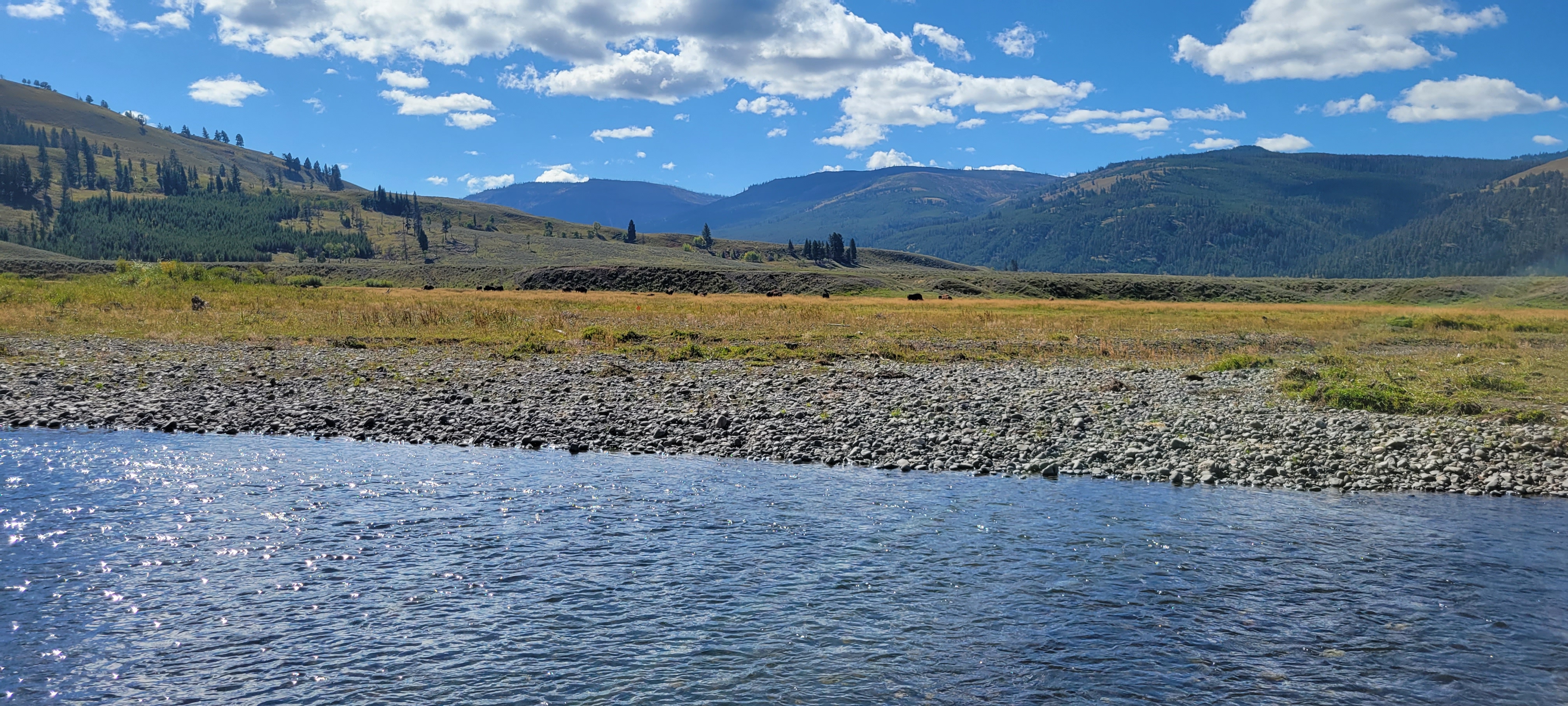
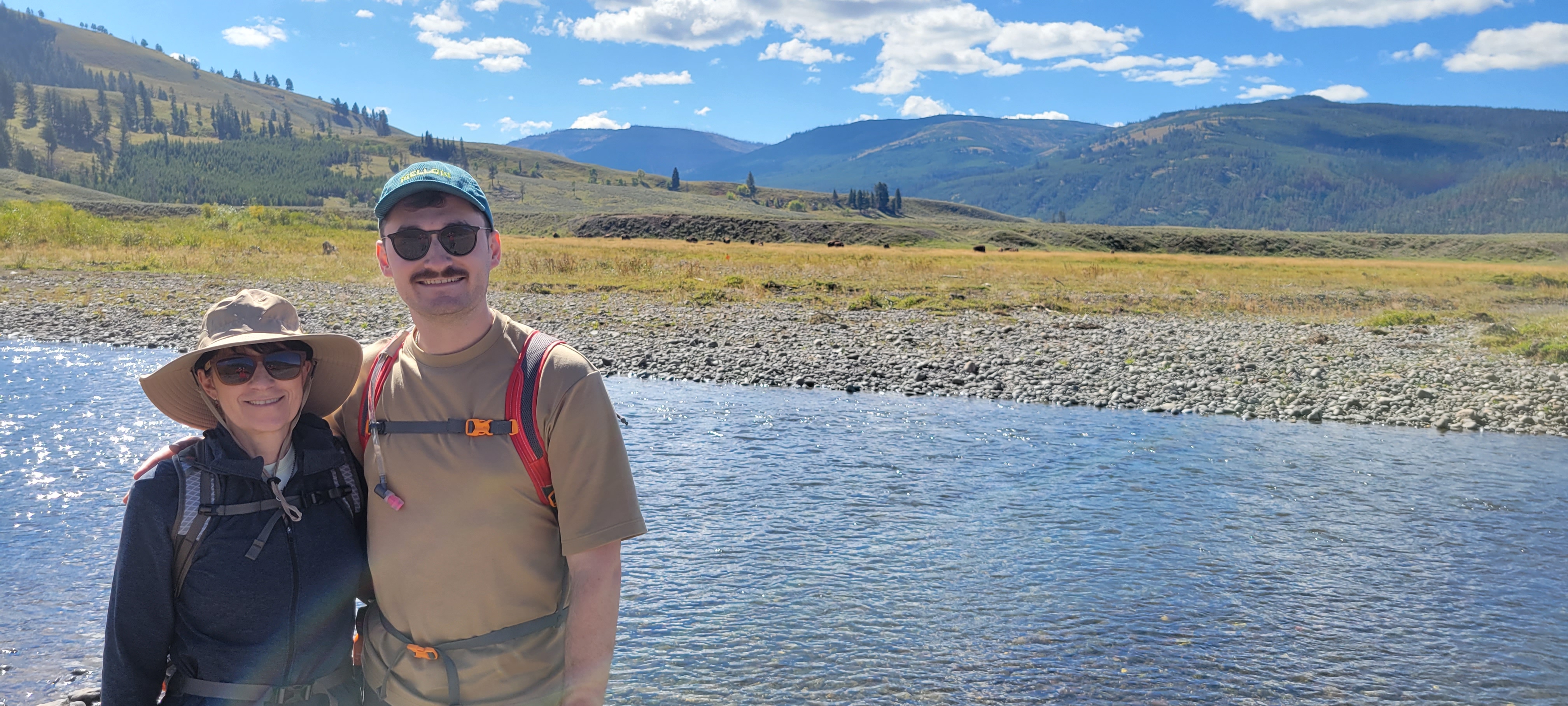
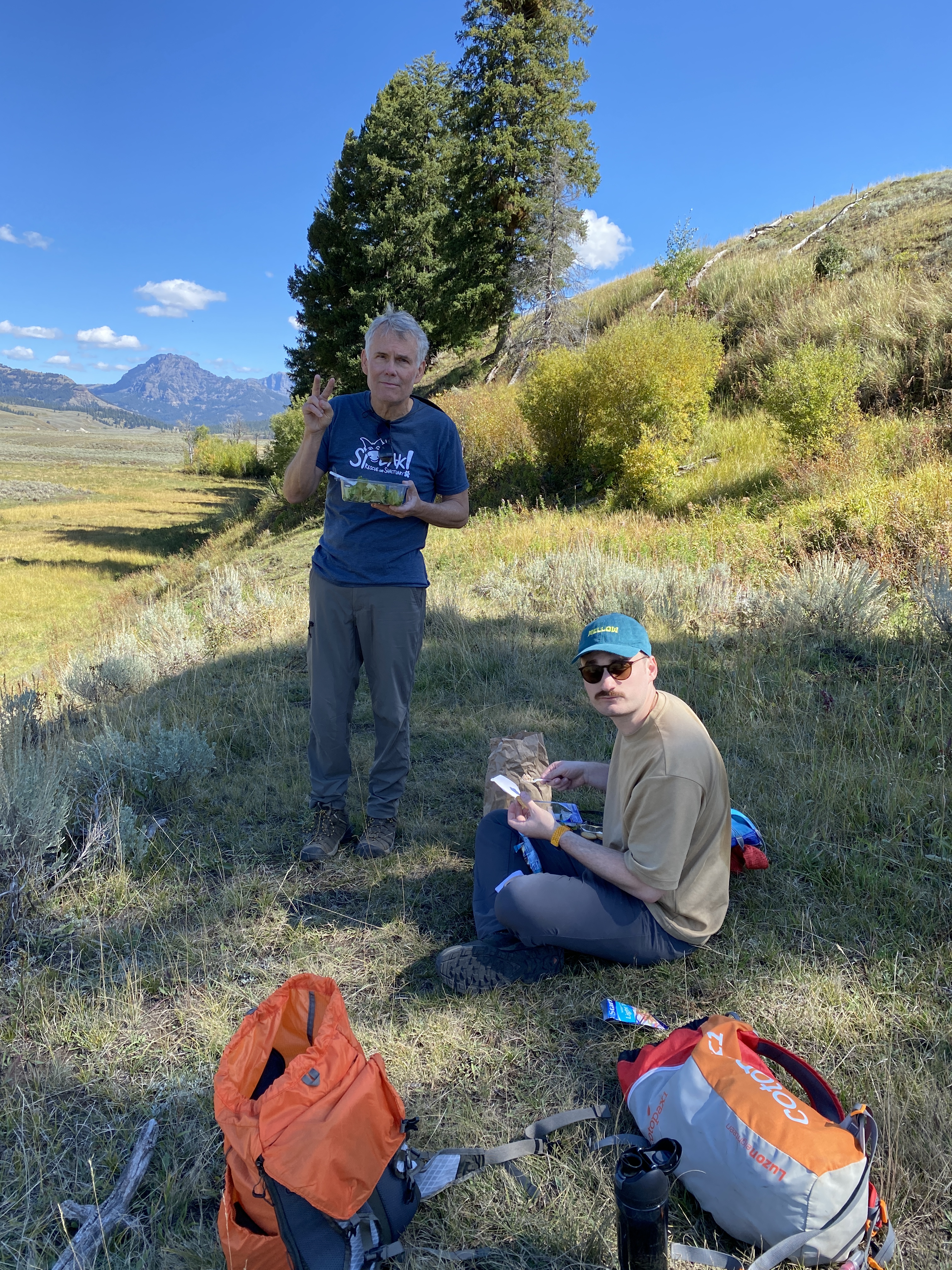
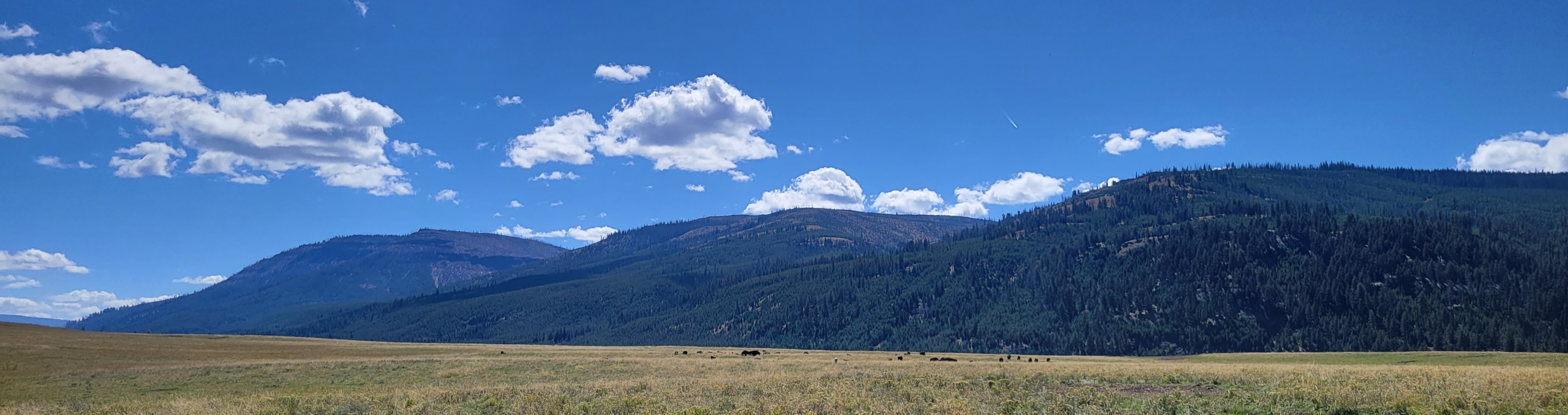
Our most memorable meal in the park, then, was probably halfway through a toasty hike in the wide-as-the-sky Lamar Valley. With a pack of bison just far enough away over our shoulders, after a quick crossing of the Lamar River, we bee-lined for the shade of a pine tree, dropped our backpacks, and chowed down*.
Mary Jo nibbled on a CLIF bar and a handful of peanuts, sitting on a little log in the grass, not far from a nice bison patty*, keeping an eye on some woods behind us to make sure some hungry bear didn’t get any ideas. Luke sat cross-legged on the grass, scooping out some tuna on crackers. I stood — easier to run from a theoretical bear — while stuffing down a mass-produced, general store-bought Caesar salad with chicken. Well, la de da.
It was awesome.
—**—
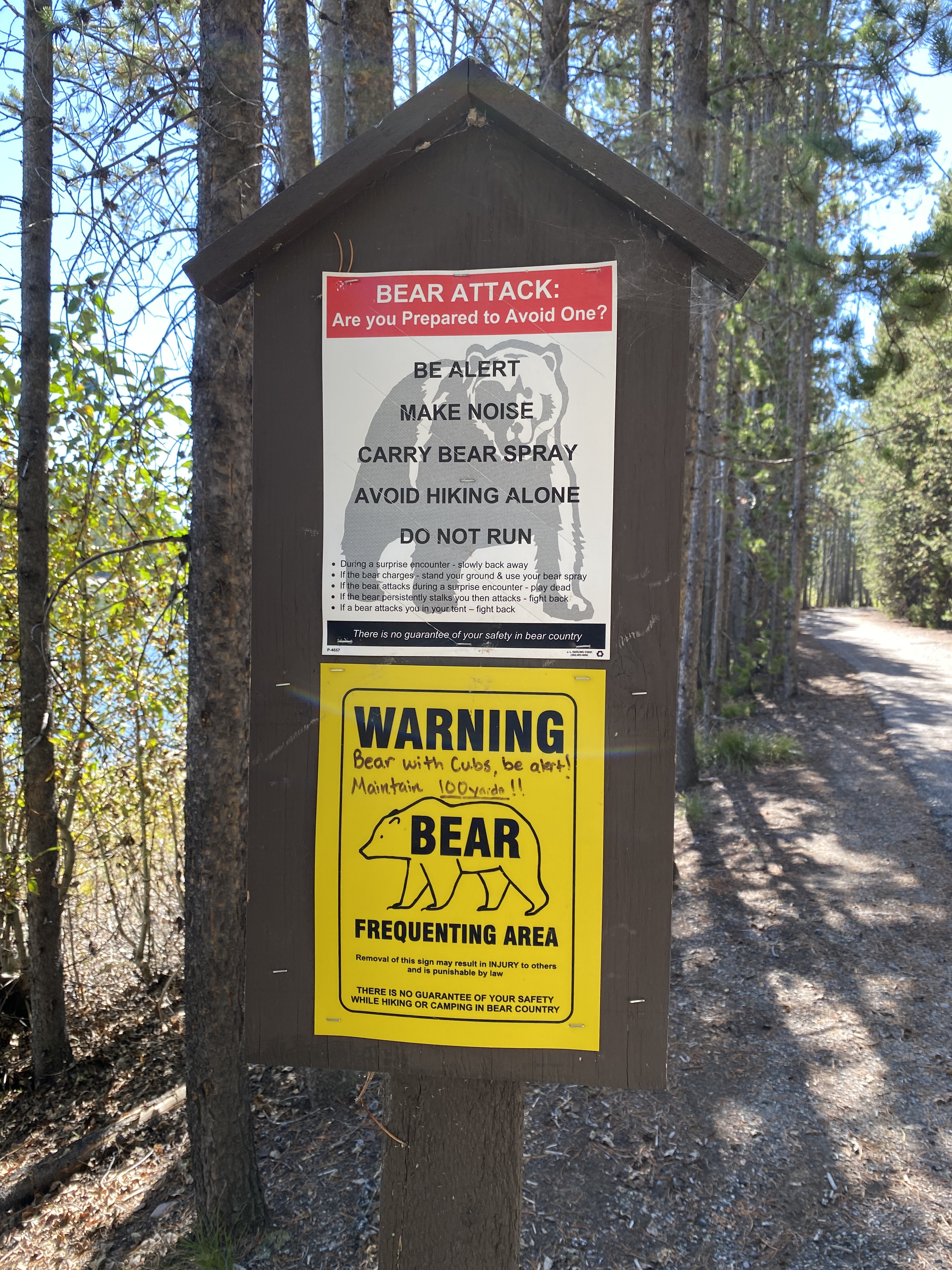
Our first day, driving from Montana through the North entrance into Wyoming (where most of Yellowstone lies), we scanned the horizon looking for bison. Yellowstone is famed for geysers, of course, and maybe more than any national park, its sweeping Western vistas. But we were after bears and cutthroat trout and wolves and, of course, bison.
“Look, over there,” someone in the car yelled that first day. (I was driving. It wasn’t me.) “Are those bison?”
A beat or two as we all craned to look. Phones were raised. Eyes squinted. Many bad photos were taken.
“Those,” someone said — again not me — “are boulders.”
And indeed they were.
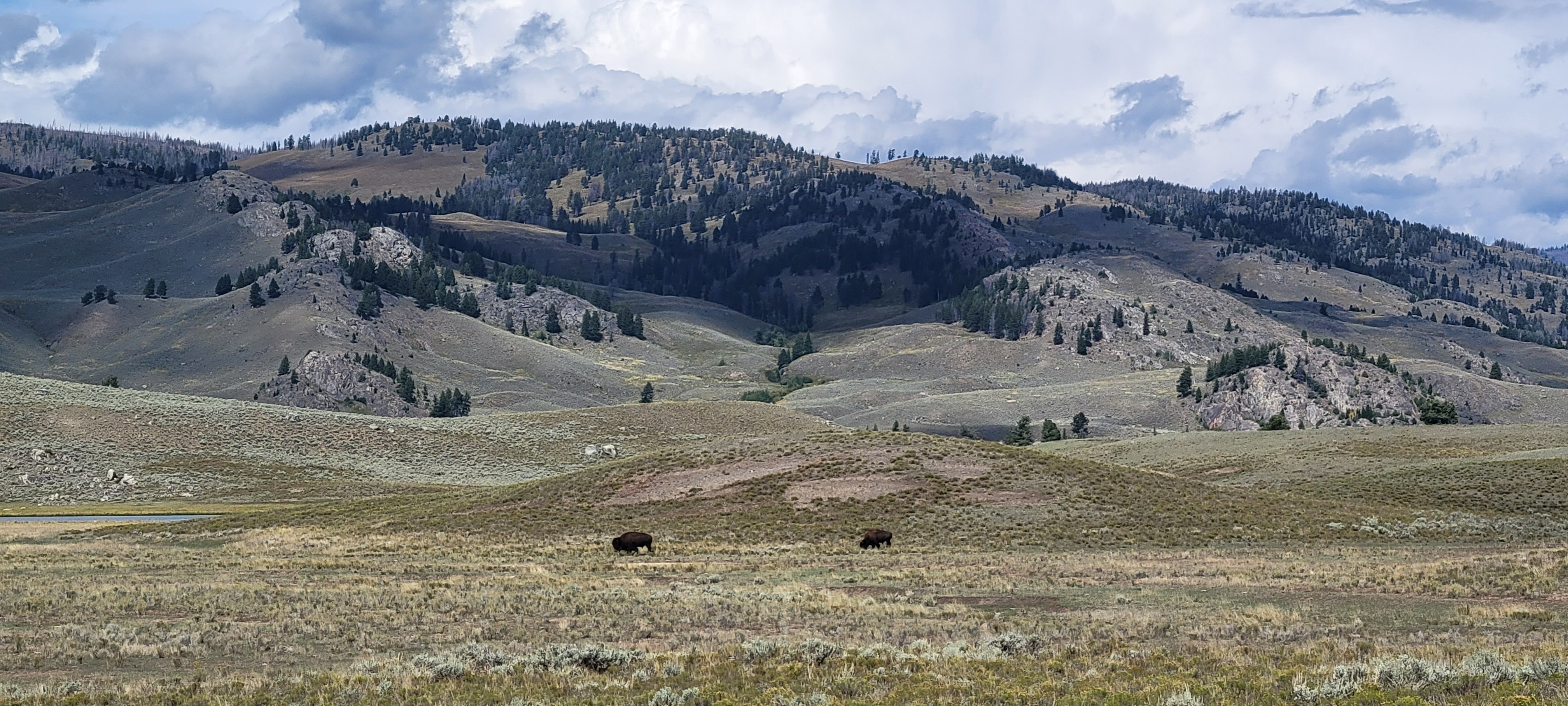
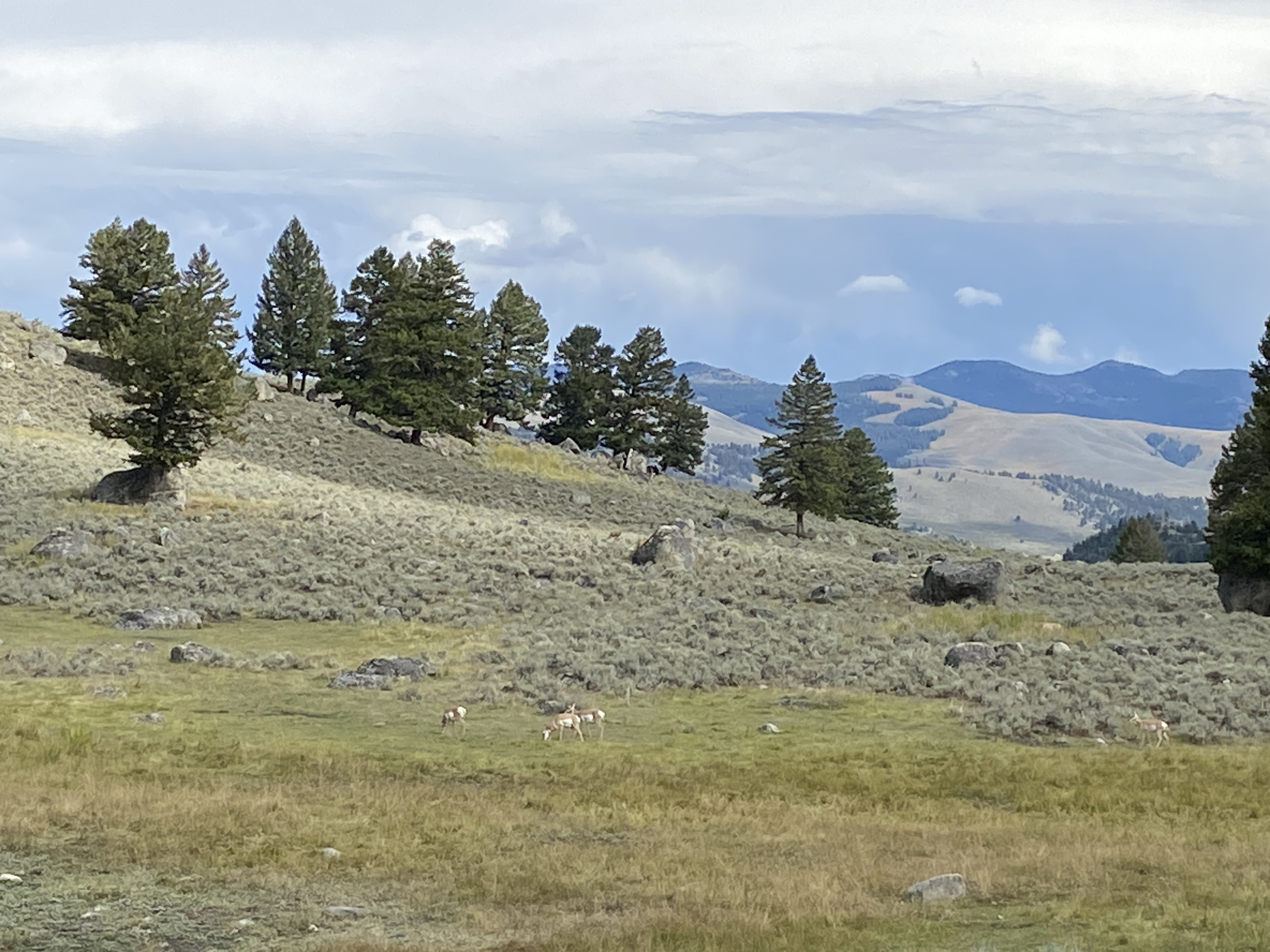
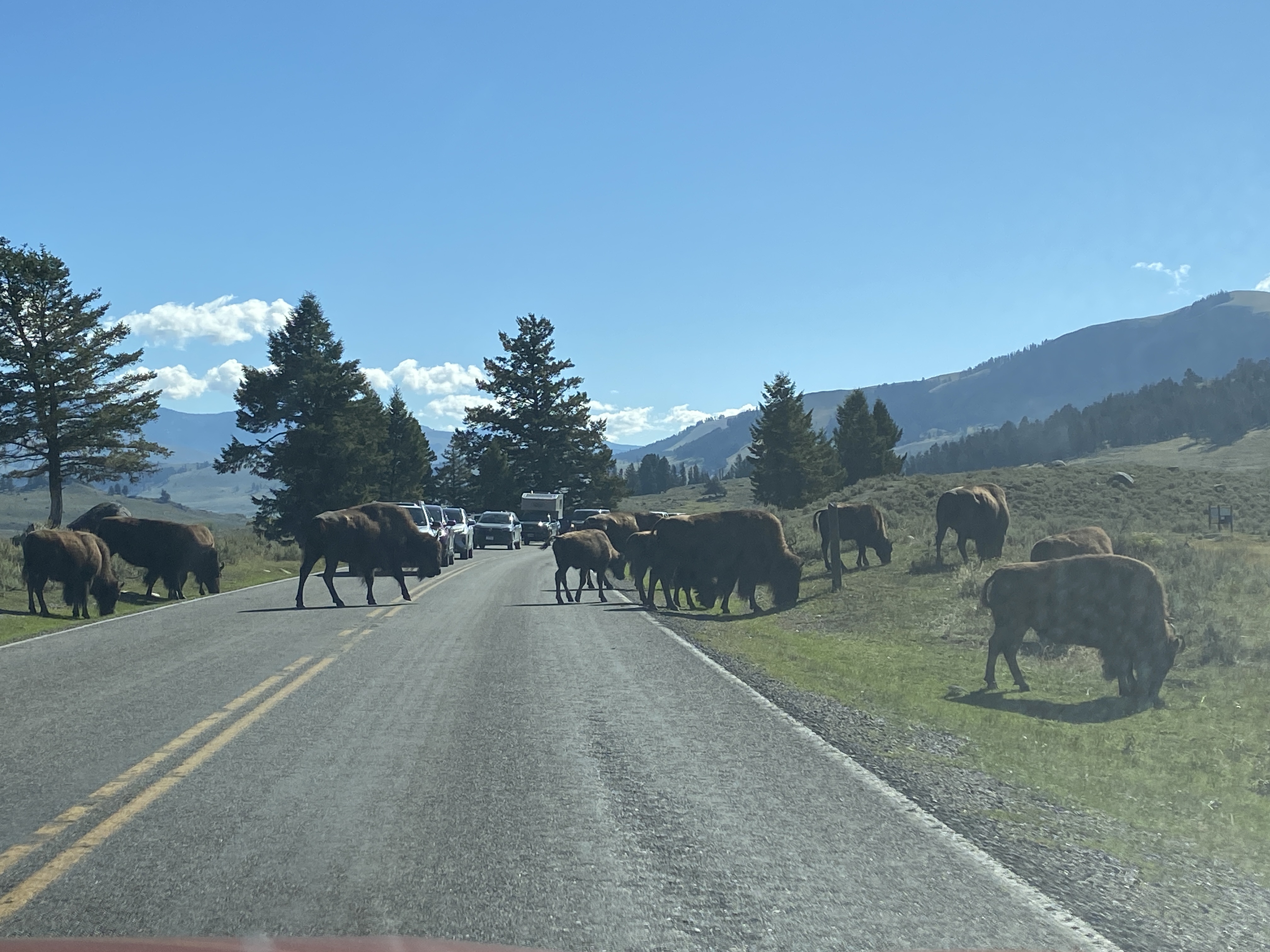
We saw real bison, soon enough, way out in the distance*. And as the days went by, we saw more, much closer. As in 10 feet away. Maybe closer*. We stopped in the roadway, first in line*, to let them cross. (It’s their damn park.) I drove ever-so carefully by, once they took their damn time crossing.
For the record, up close and personal*, they are big and furry and not particularly handsome. But they are wild, and they are bison, for Pete’s sake. When you’re out there, you almost have to remind yourself of how unusual that is. Rocks, you can see anywhere. Bison, not so much.
—**—
We got lots of advice before our trip to Yellowstone and did plenty of research. One piece of advice that proved well worth it: We spent $15.99 on an app that tracked us, using GPS, and featured a professional-sounding tour guide that offered suggestions on what to see and how to see it. During long stretches of driving, he regaled us with all sorts of insight into the park, its history, and its inhabitants.
The dude sounded a little full of himself, for sure. Kind of a wannabe Casey Kasem (a dated reference, I’m aware). Some of the banter became a little old, especially when we looped around and found ourselves on an already-traveled stretch of road. Wolves were reintroduced to the park in 1995. Bison can run up to 35mph. Some dope put a bunch of regular trout in the lakes and almost wiped out the cutthroat trout. We were finishing this guy’s sentences by the end of the week. We got it, Casey. We got it.
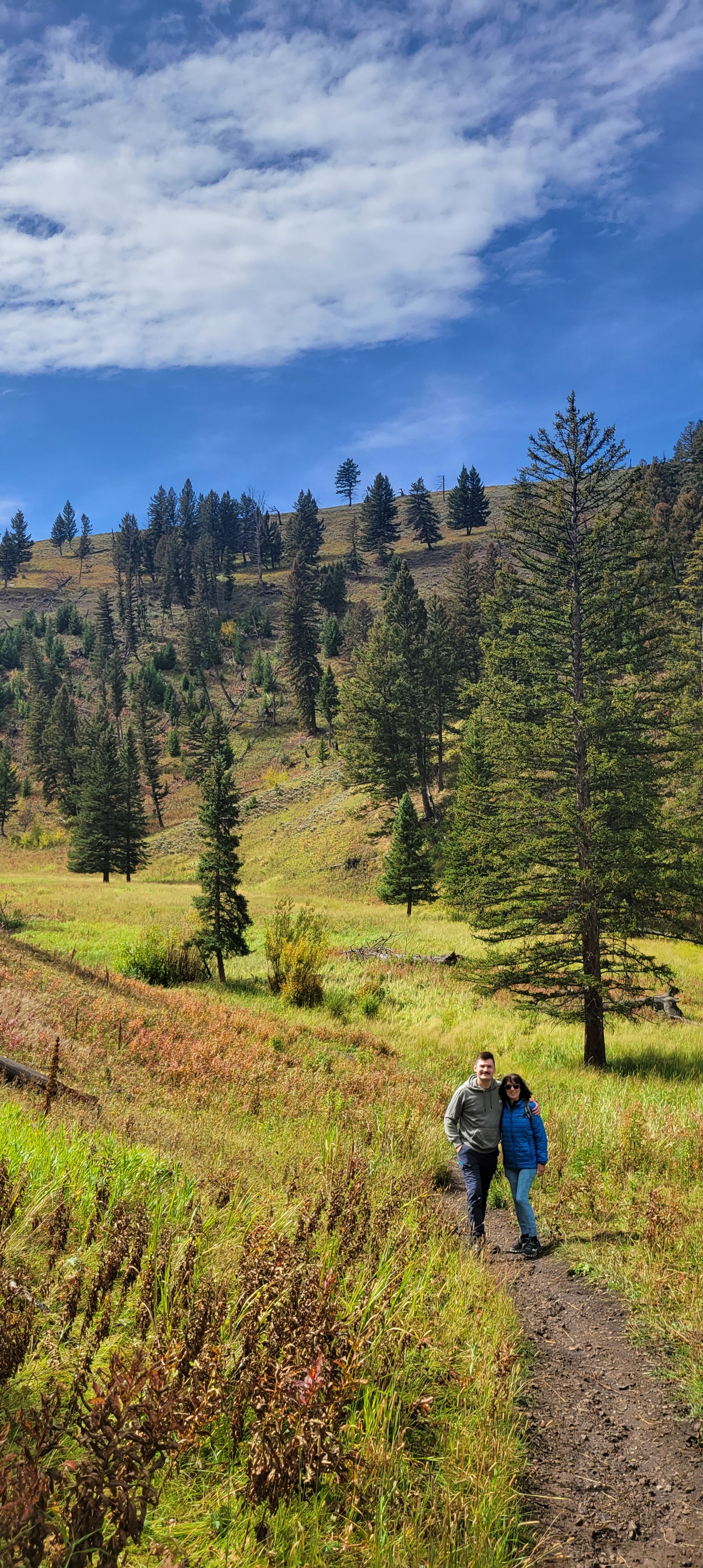
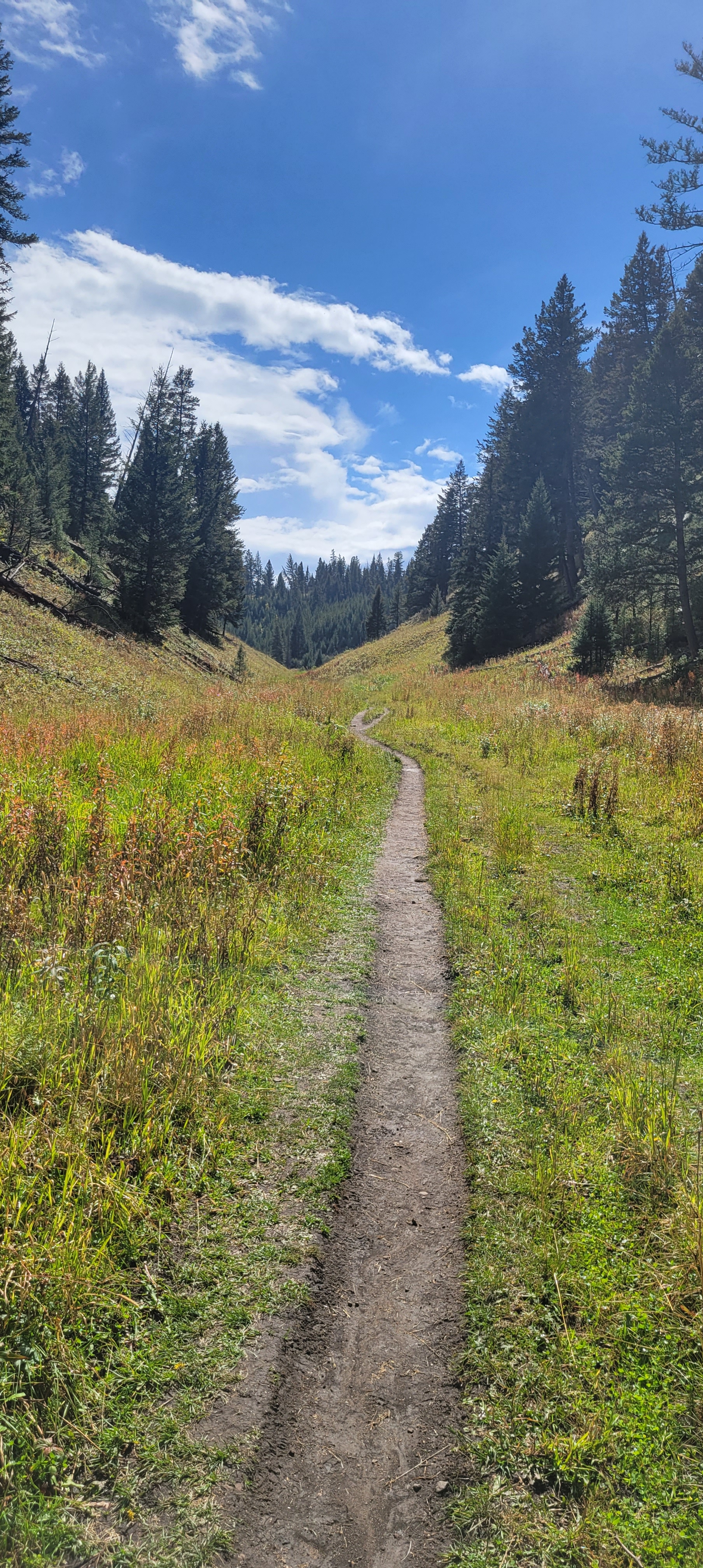
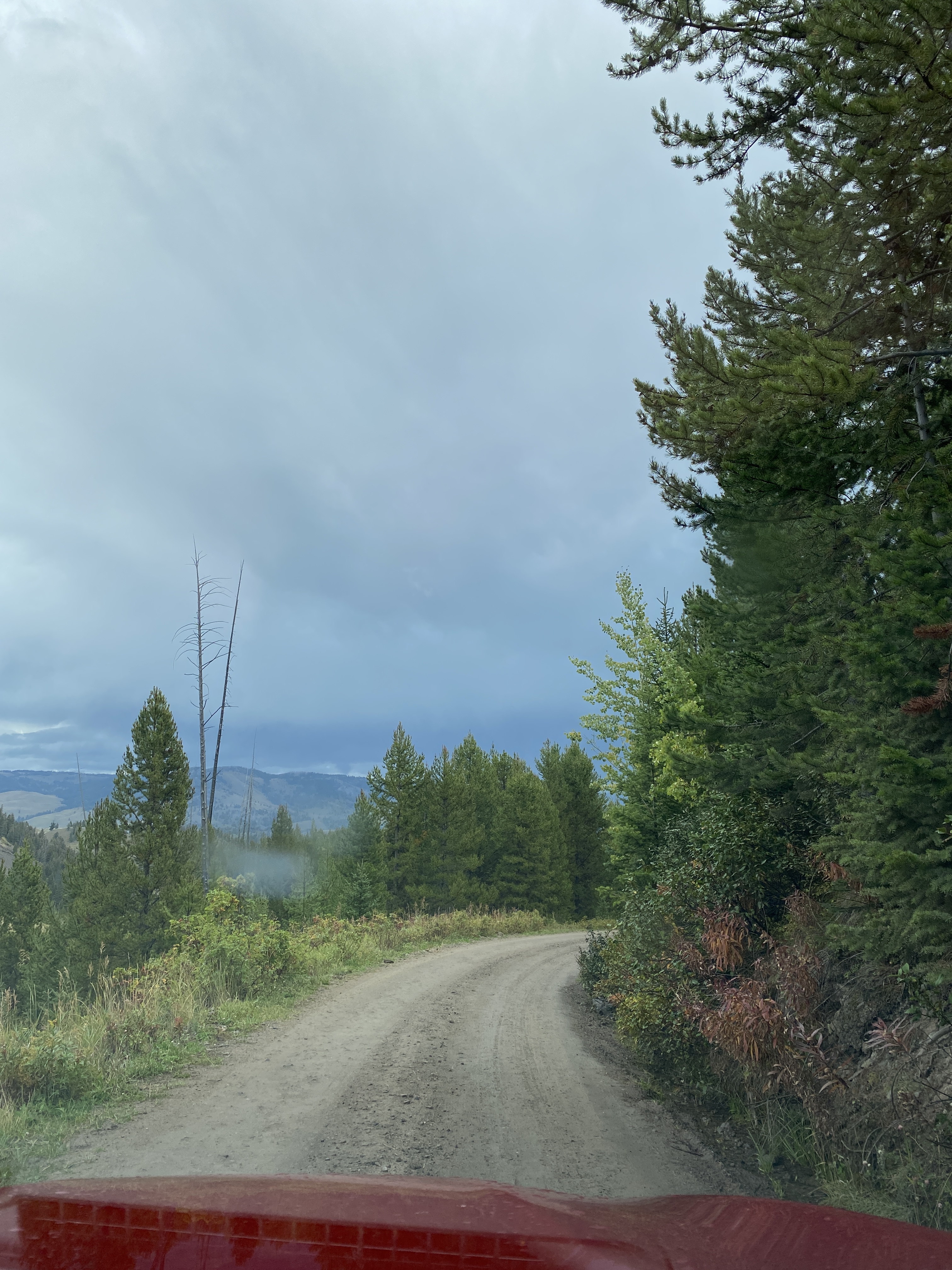
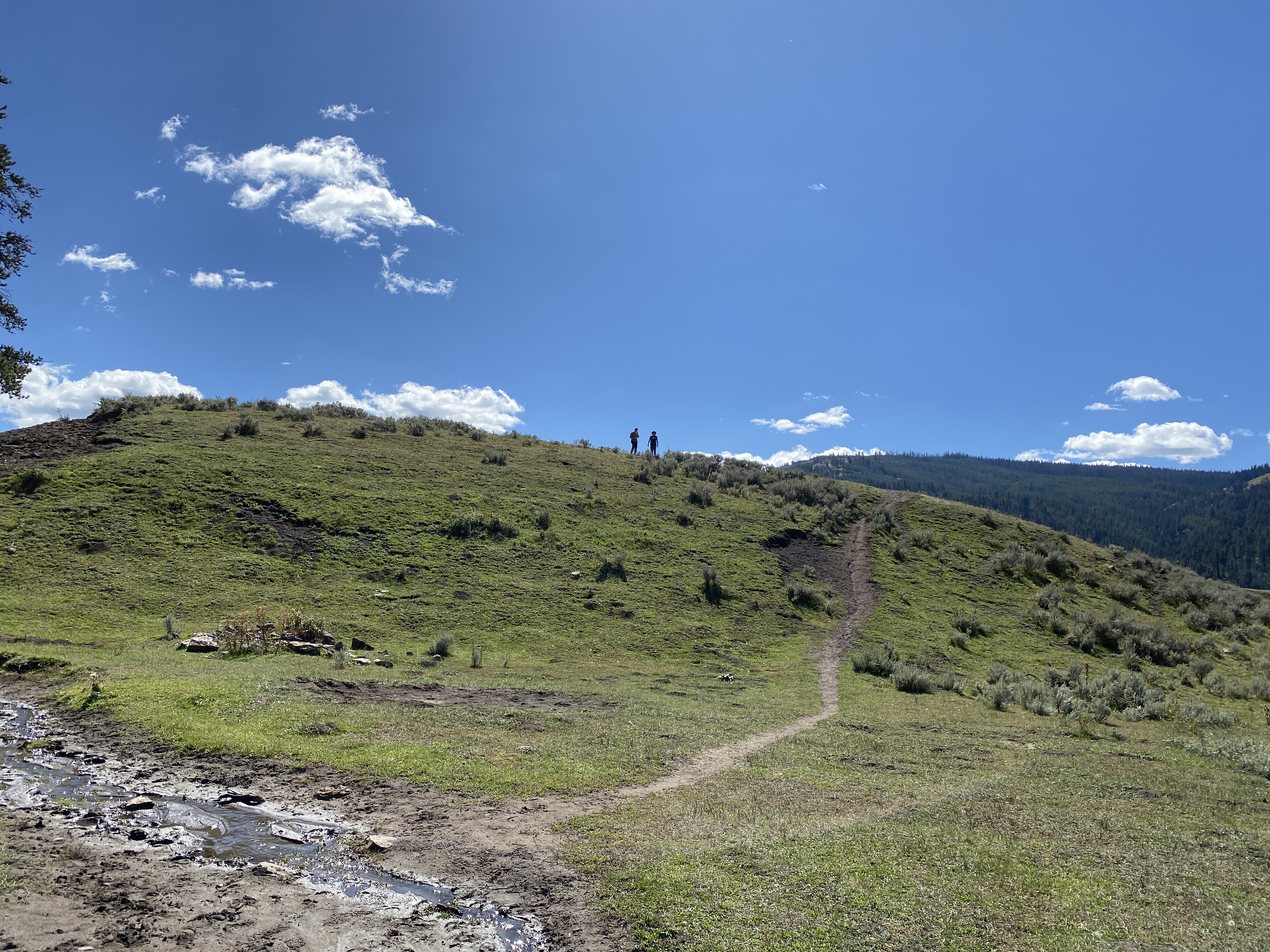
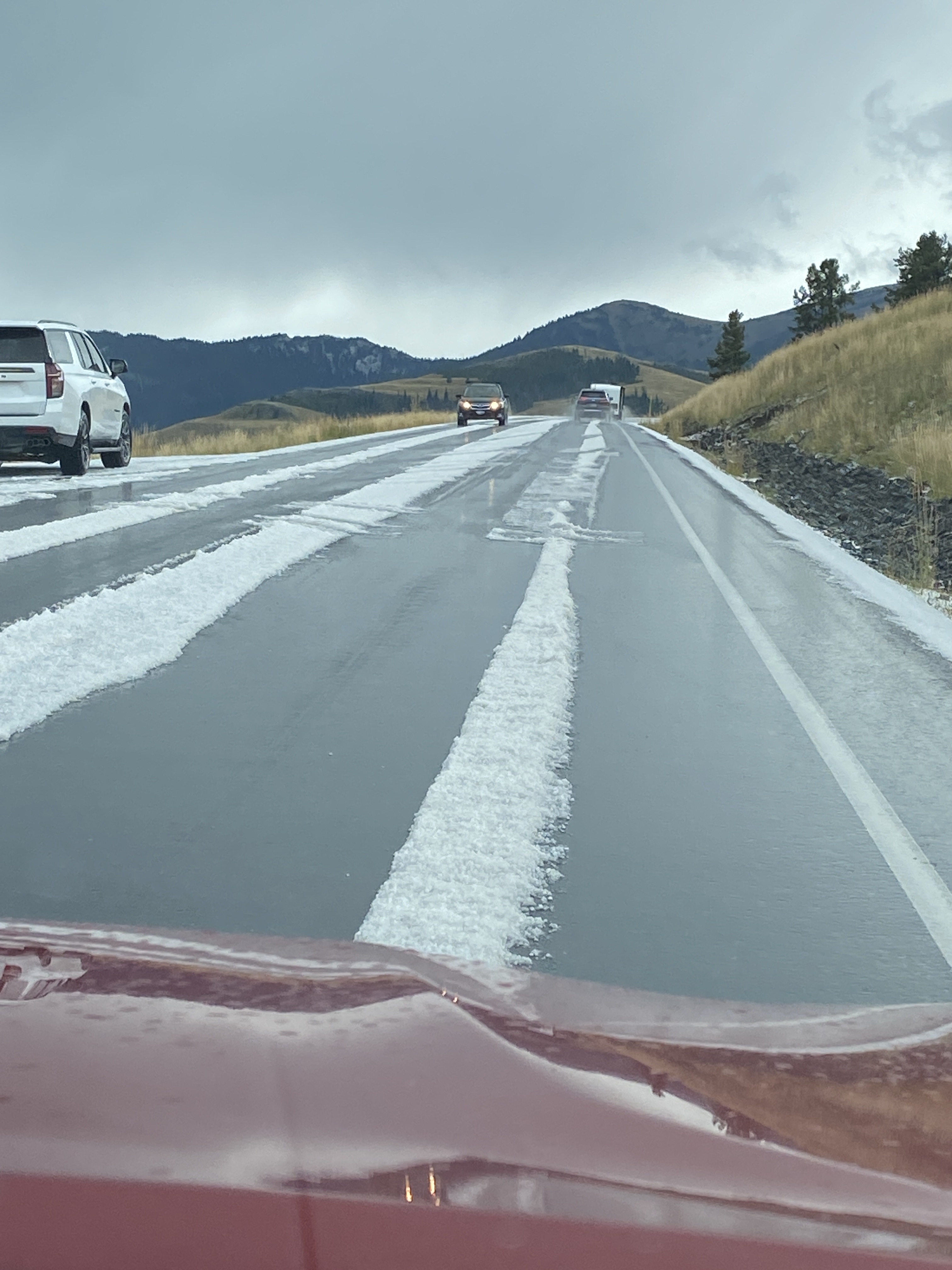
Still, he suggested a tucked-away one-way dirt road that took us into some beautiful country*, and another that took us up a rainy mountaintop where Luke jumped out and disappeared for a short time. The voice pointed us to a kind-of-lousy tourist spot where we pulled off and found, pretty much by avoiding the lousy tourist spot, our best hike of the week*.
I kind of miss Casey, even if he did repeat himself. Happens with a lot of us.
—**—
Yellowstone can be crowded. Newsflash there. Almost 3.3 million people visited in 2022. The Top 10 national parks in visitors last year:
- Great Smoky Mountains
- Grand Canyon
- Zion
- Rocky Mountain
- Acadia
- Yosemite
- Yellowstone
- Joshua Tree
- Cuyahoga Valley
- Glacier
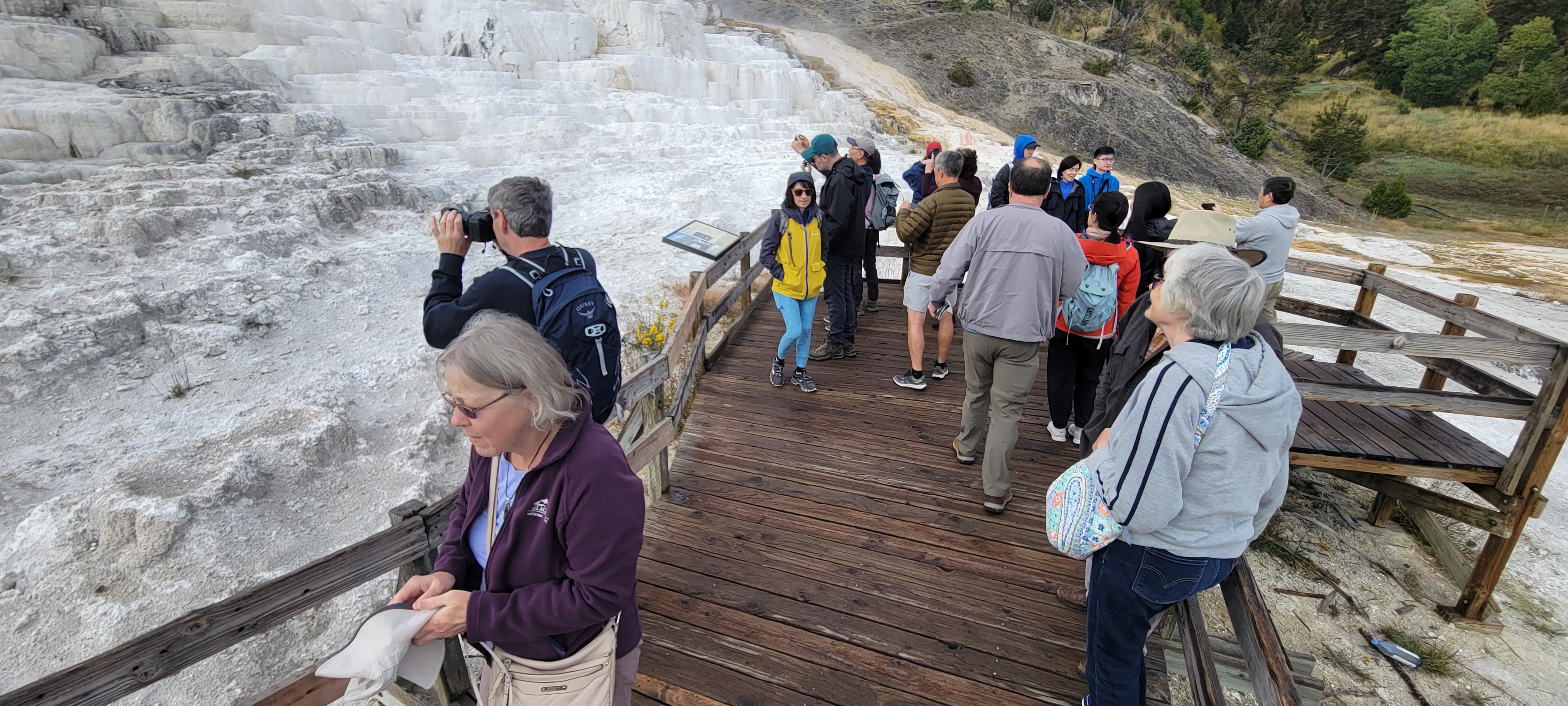
Crowds are no fun. You don’t go to a national park for crowds. (If you want crowds, go to the beach.) We missed the worst of the masses — in late September, the kids are back in school and the grownups are mostly back at work — but in our first stop in the park, outside the north entrance, in a place called Mammoth Springs, we ran into tour busses and just way too many people*.
We are not experts at this — these guys are — but we have been to eight of those Top 10 (^), plus a few more, and we’ve learned how to sidestep crowds for the most part. A couple pointers:
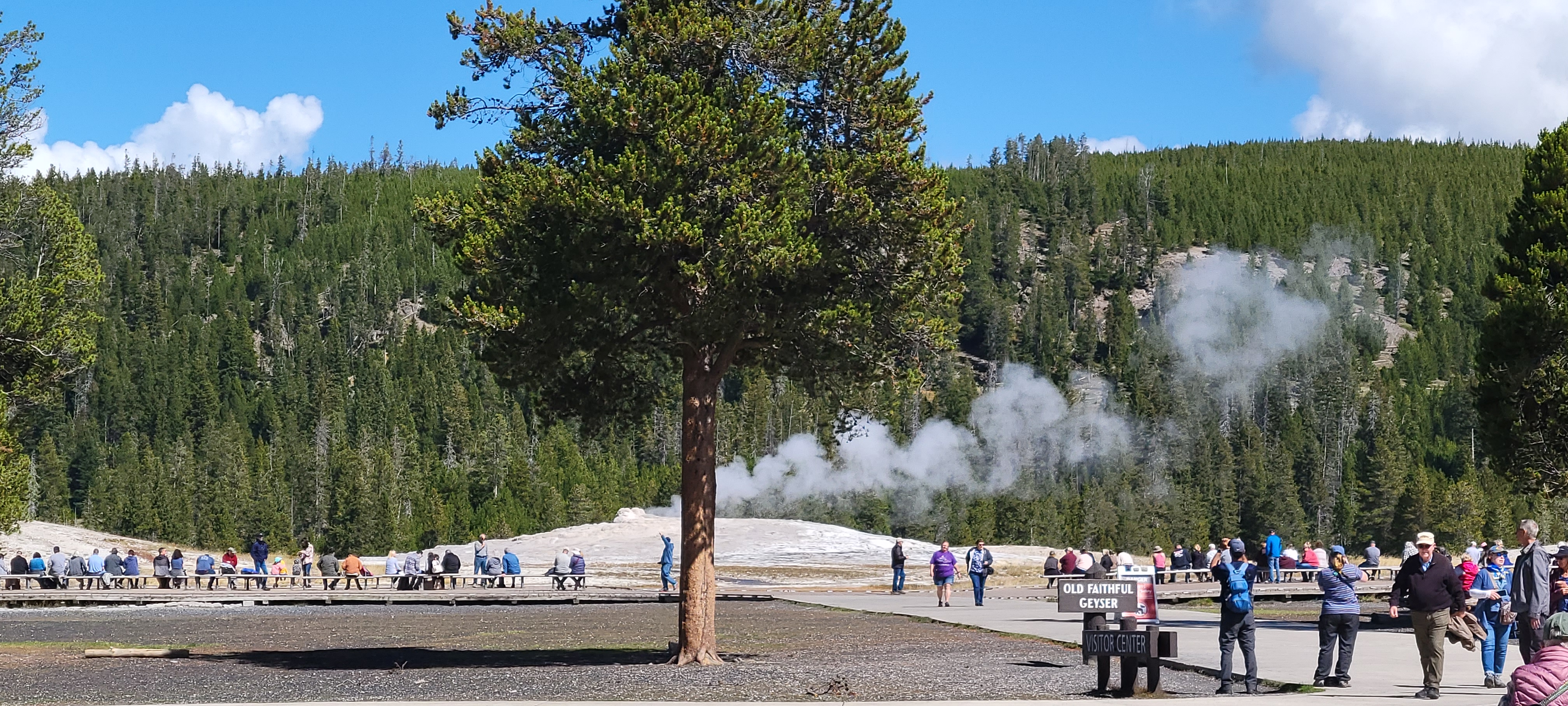
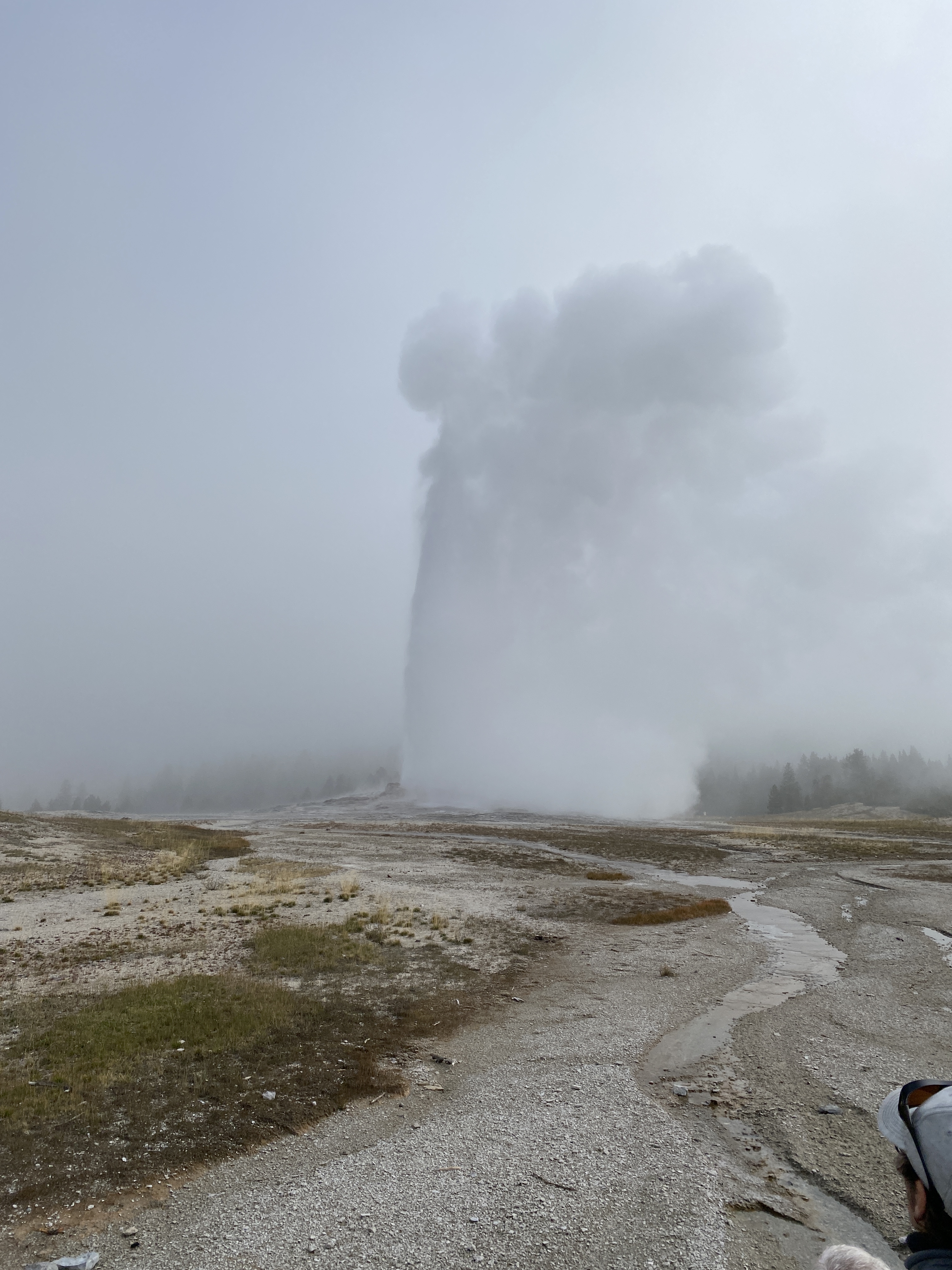
- The crowds go to places for a reason: They’re worth going to. You don’t go to Rome to not see the Coliseum. So, using Yellowstone for an example, go see Old Faithful* and the beautiful, winding boardwalks in the western part of the park. Go see Artist Point* over on the East side of the big loop that covers the center of the park. But get there early (or, if you must, go late). They’re worth it. At Canyonlands National Park in Utah, across the street from the visitors center, of all the places that might be packed with camera-toting tourists, there’s an awesome panorama that takes in a vast, deep canyon, with mountains in the distance, that shouldn’t be missed. It’s absolutely worth it.
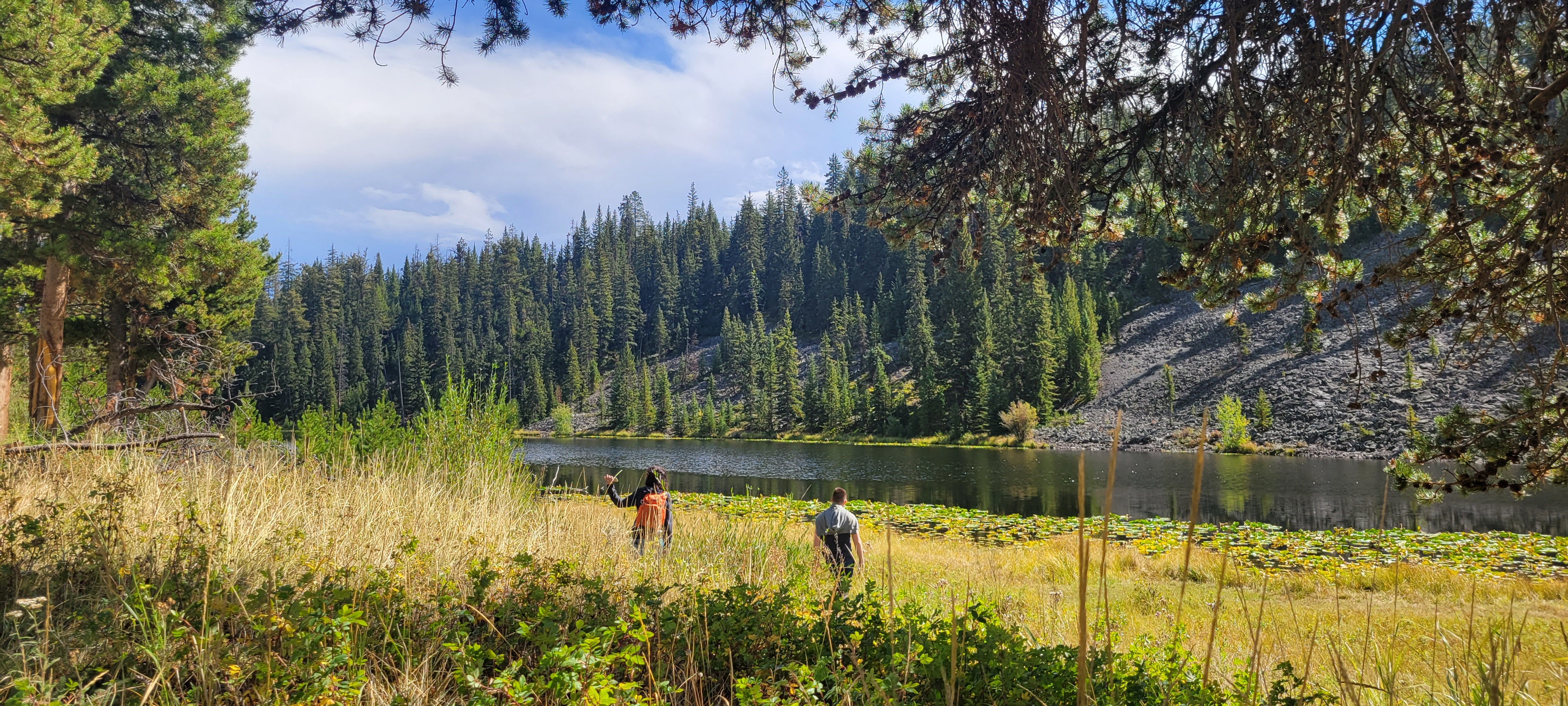
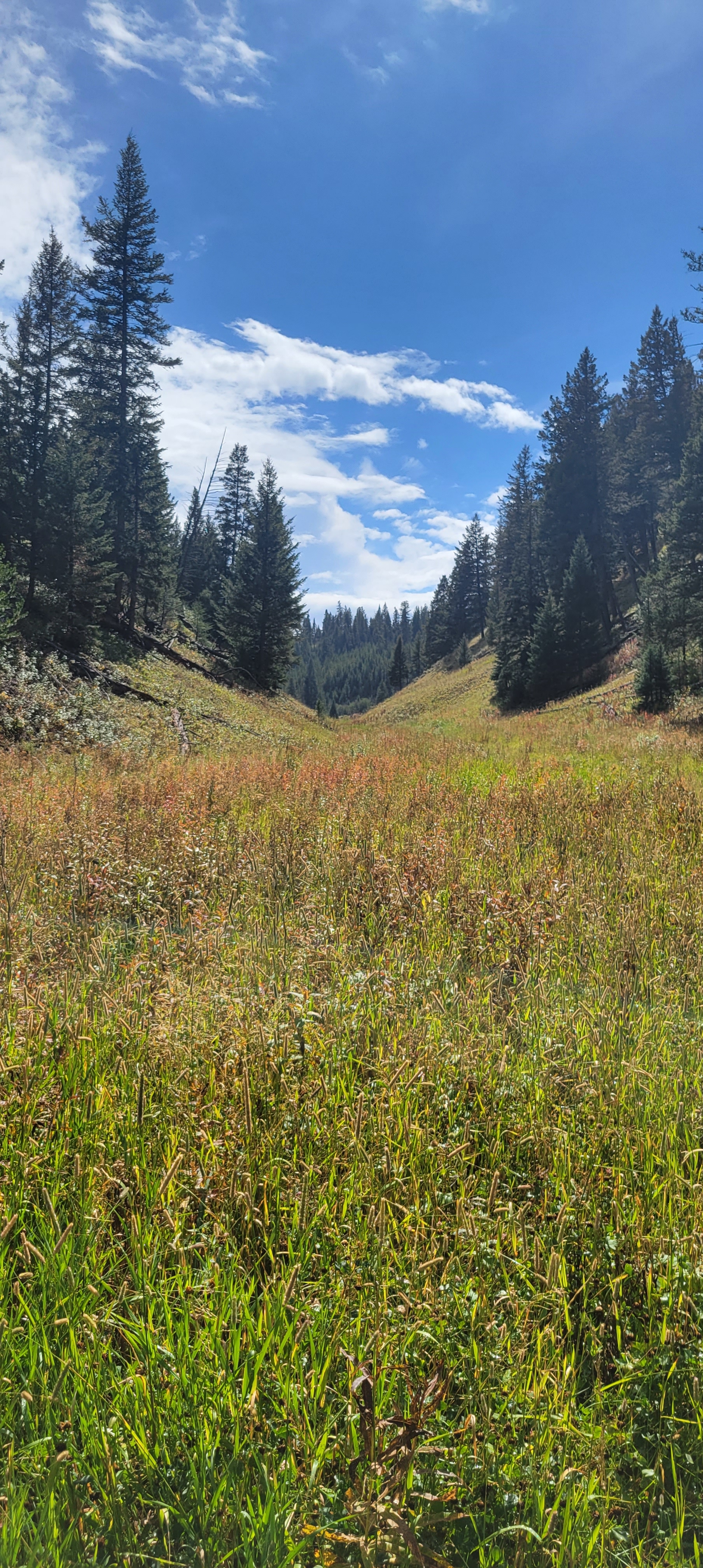
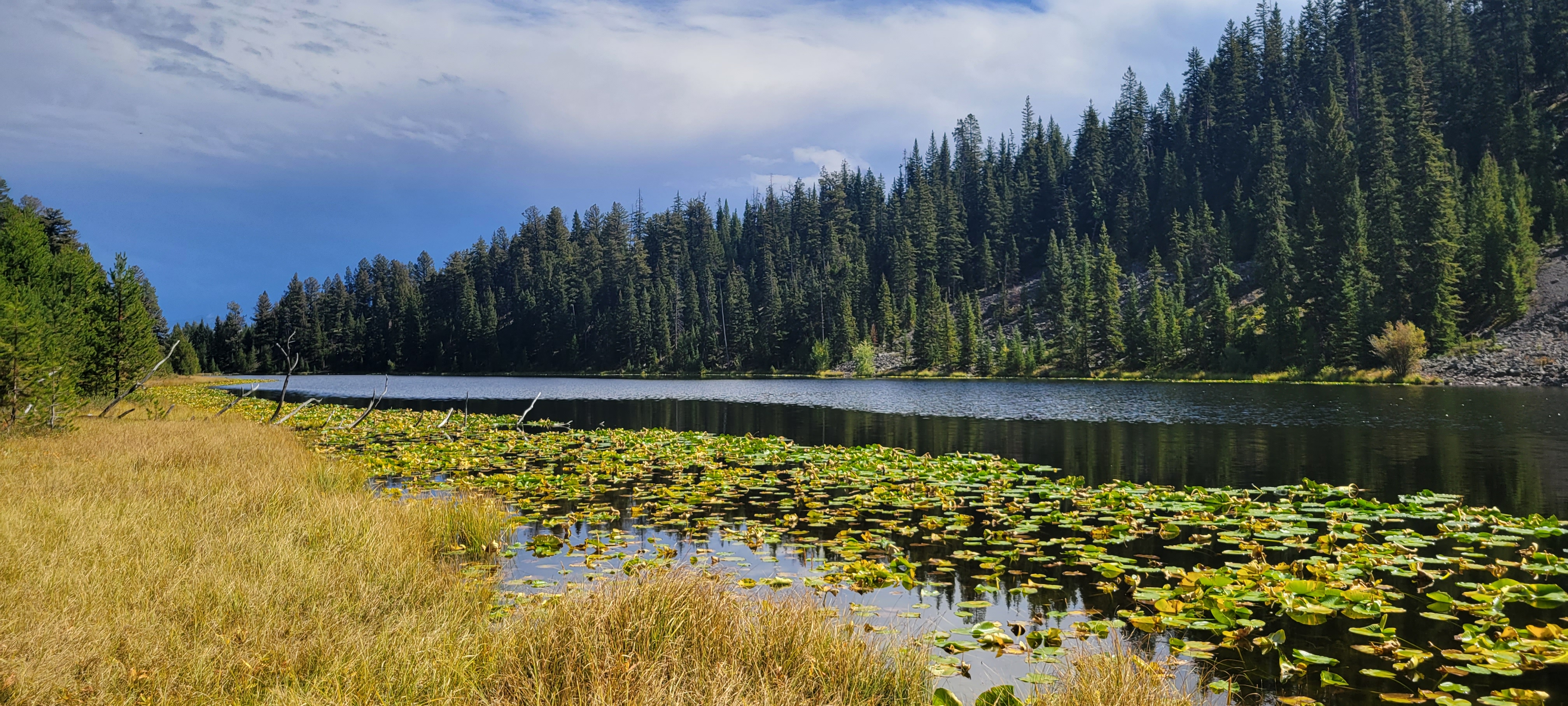
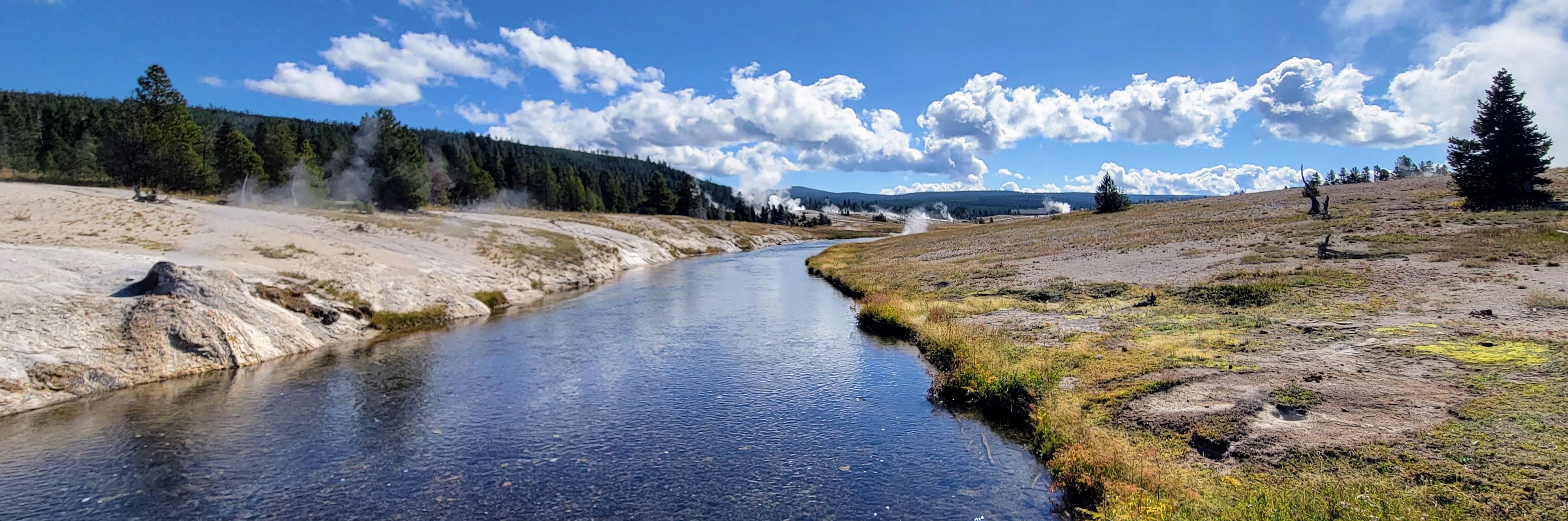
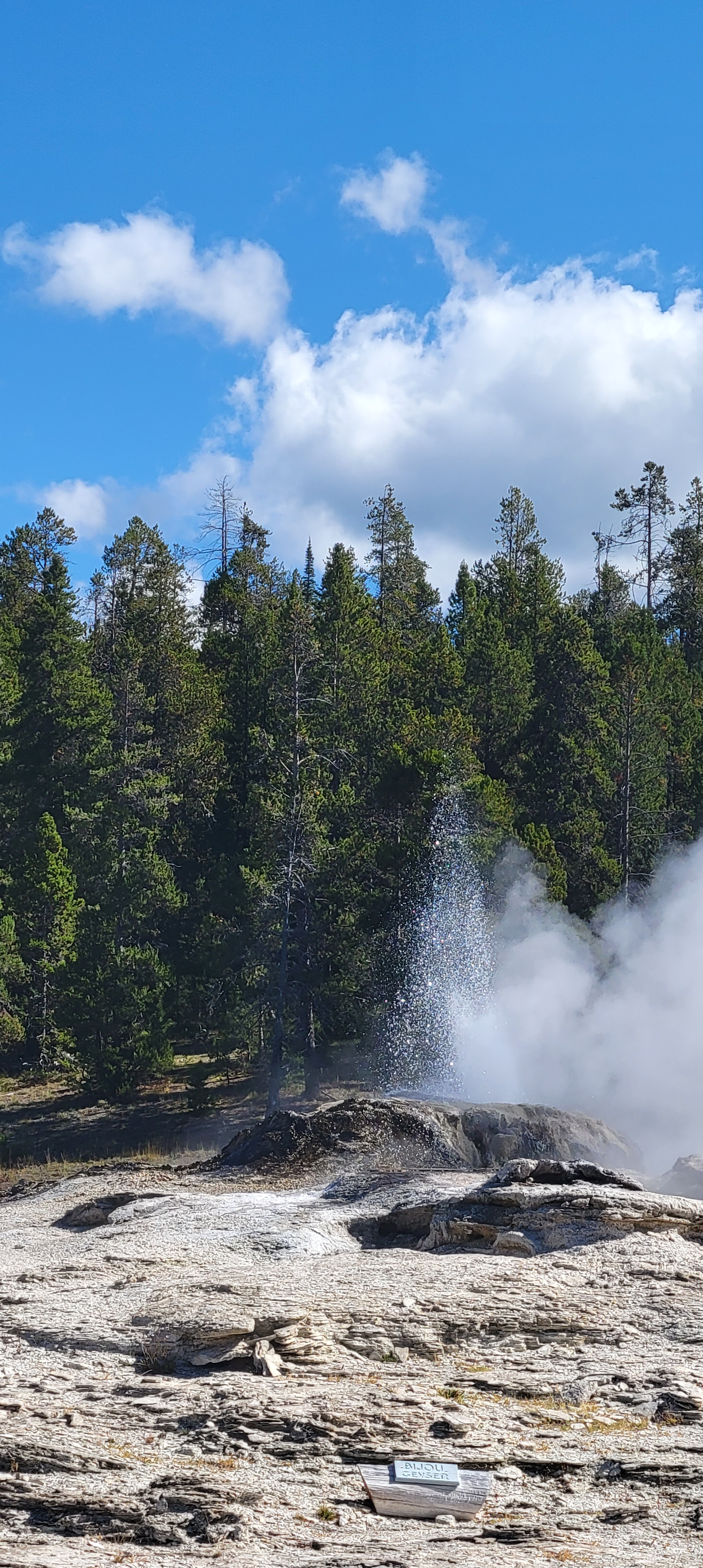
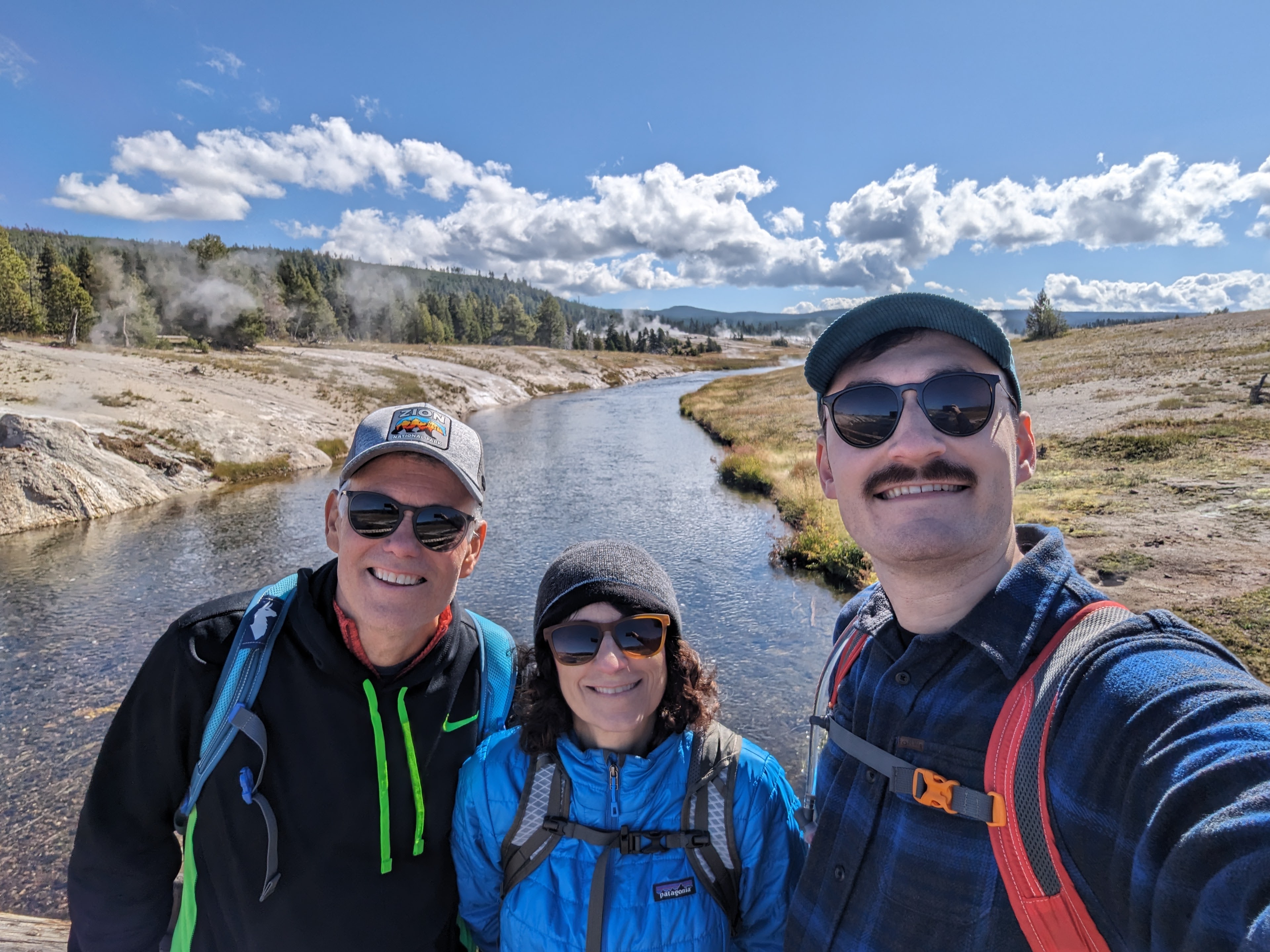
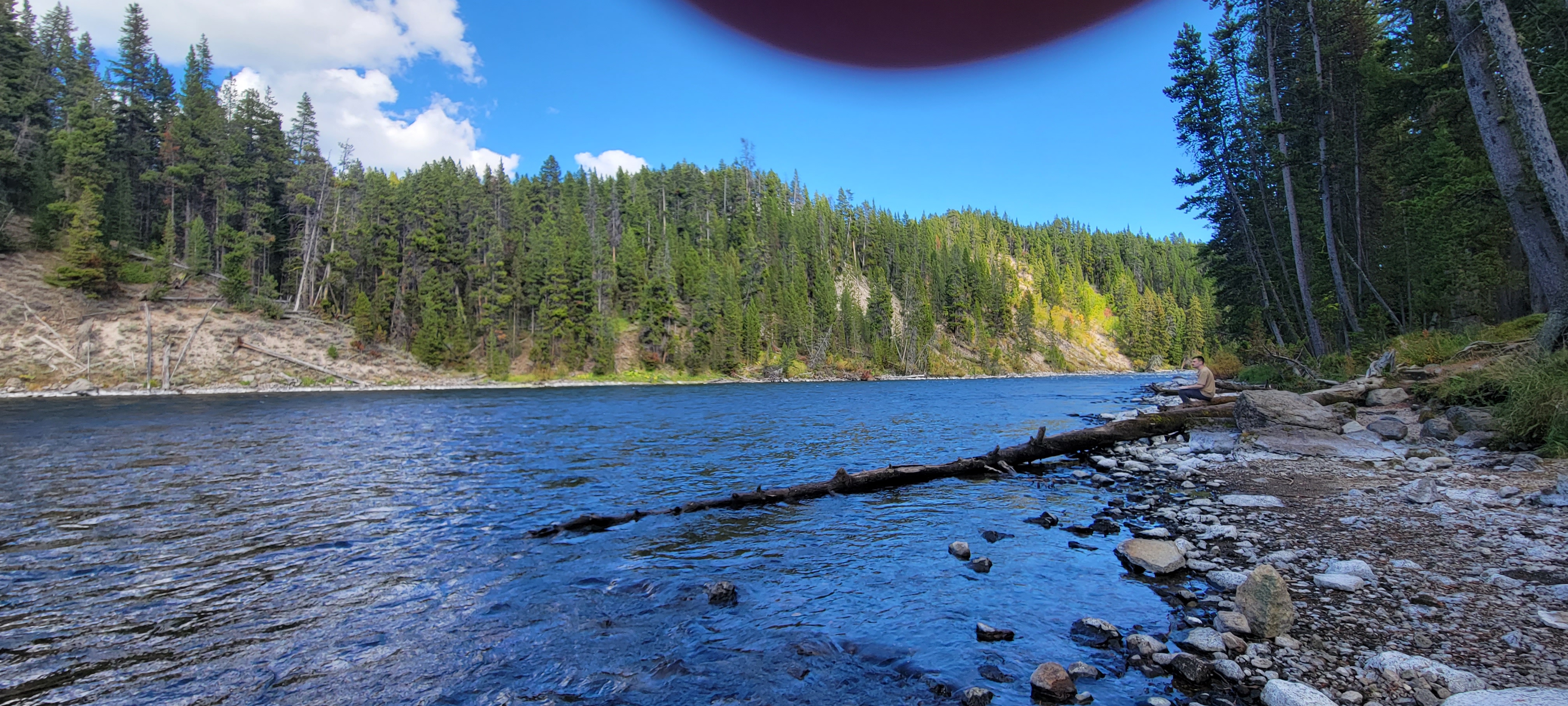
- That said, as you’re driving around these massive parks, pull off the road when the urge strikes you. (Casey suggests this, too.) Walk a little bit. It’s not hard to find a quiet place, often completely unattended, with awesome views. We found a meadow in Rocky Mountain NP like that. And in Yellowstone, we veered from that bad tourist spot mentioned above toward a well-hiked but absolutely deserted trail to a place called Lost Lake* that was stunning. Same for a boardwalk along some Yellowstone River rapids*. Uninhabited but for us. Breathtaking.
—**—
Not for nothing, here’s a snapshot of the other park we knocked out while we were in the Great West. (That’s not even a term, let alone a capitalized one. But I’m sticking with it.)
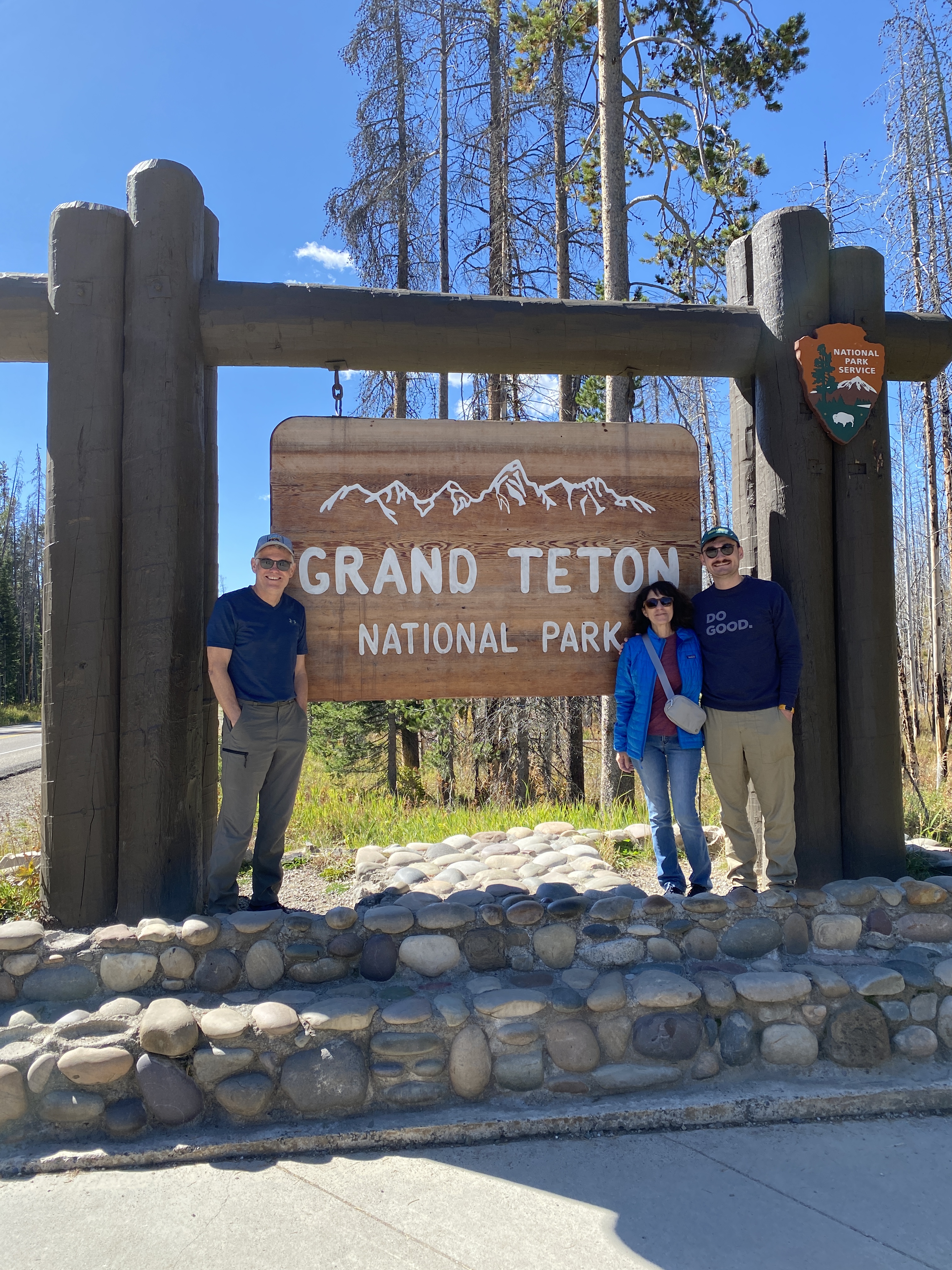
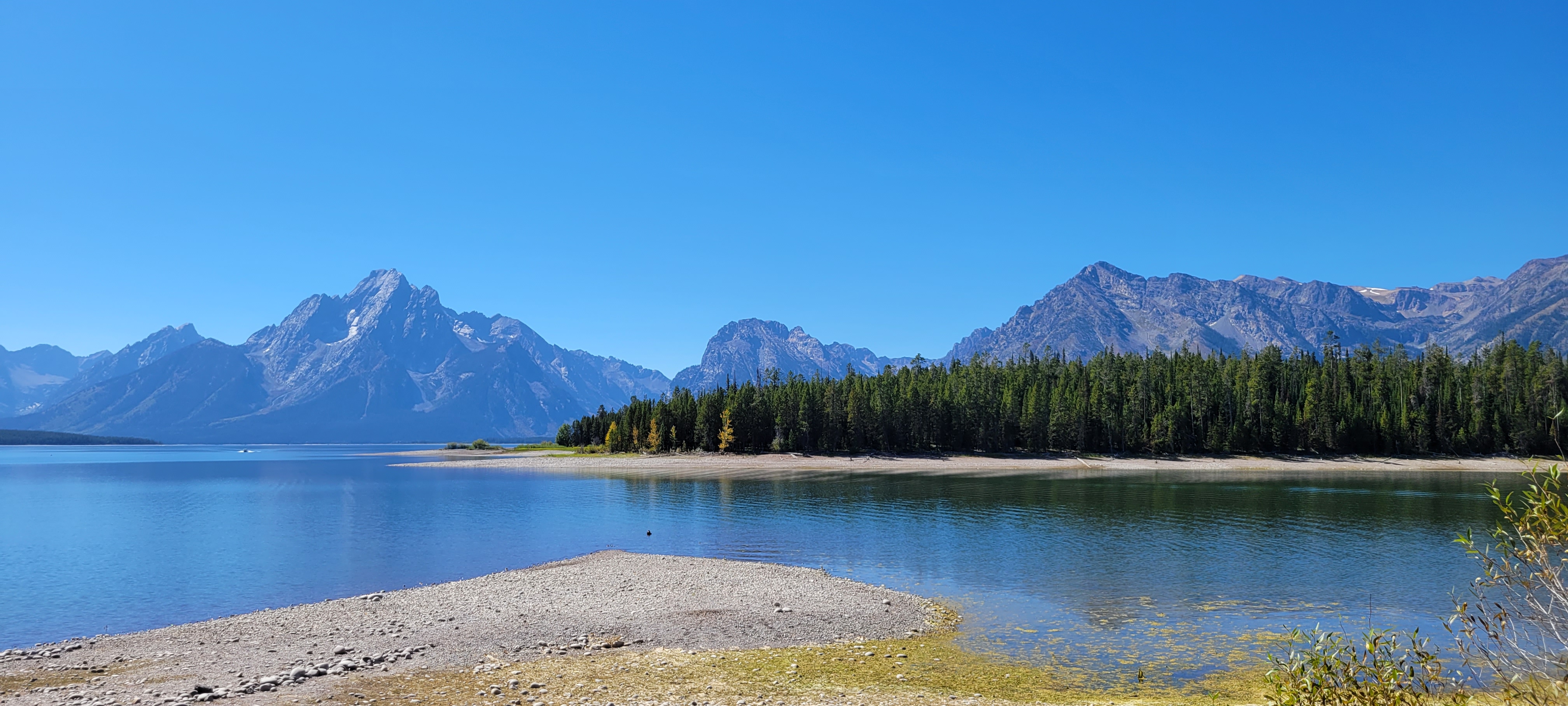
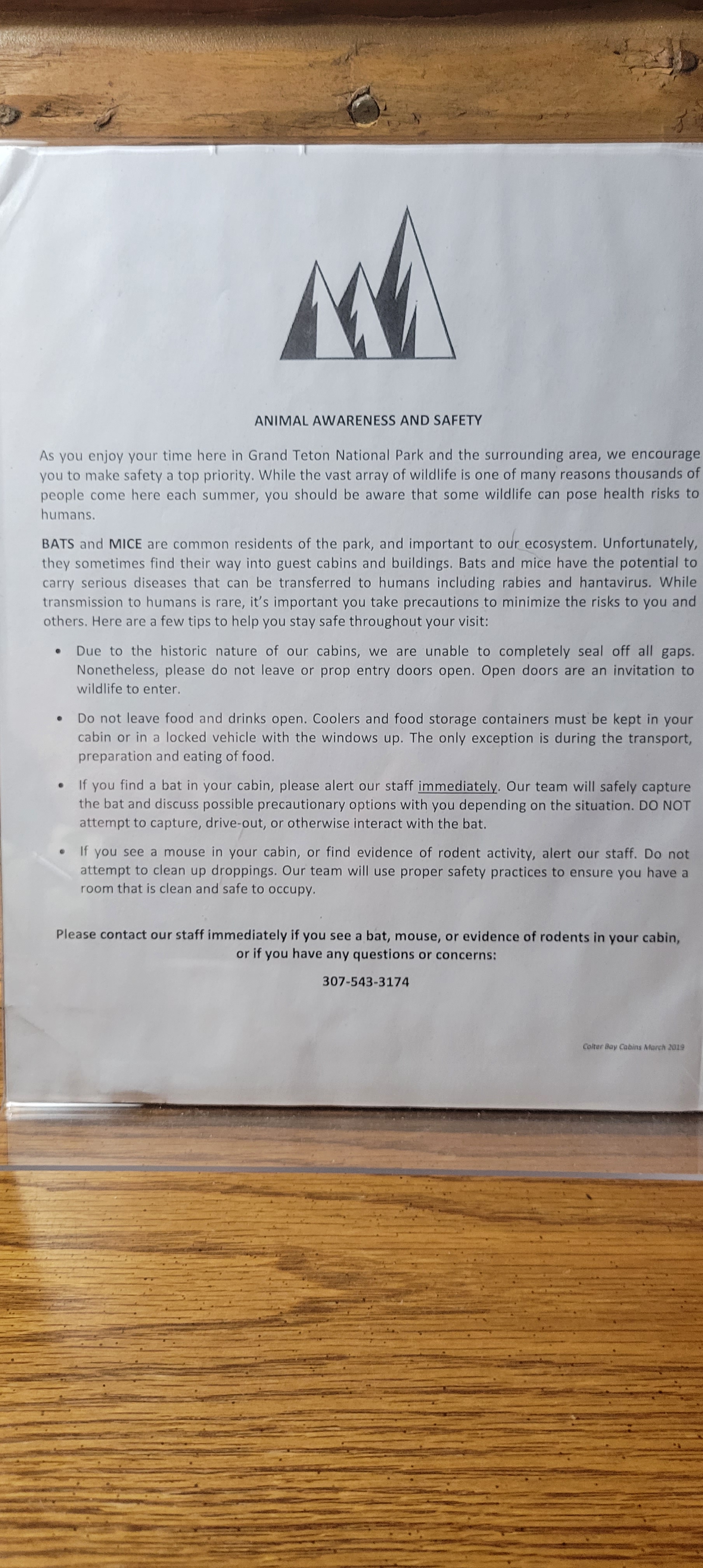
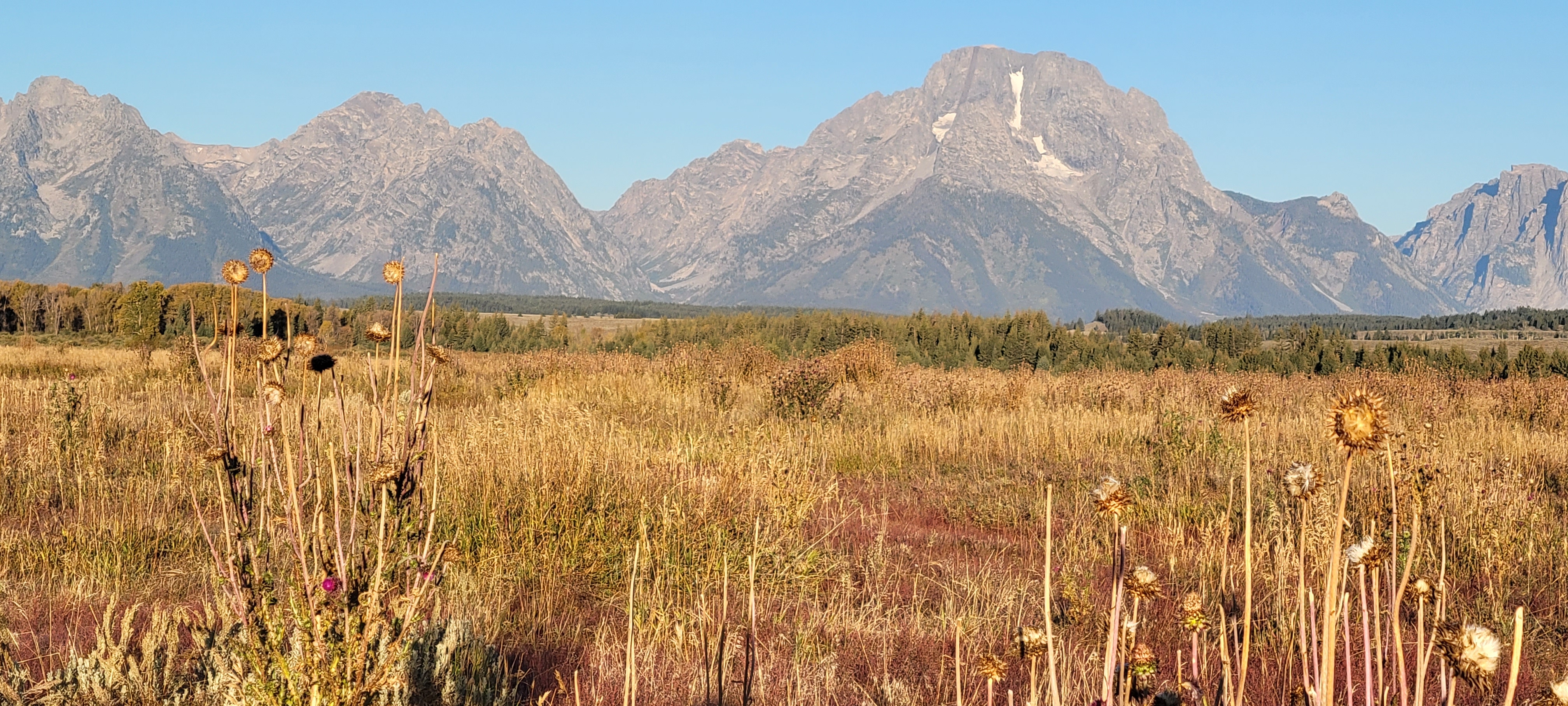
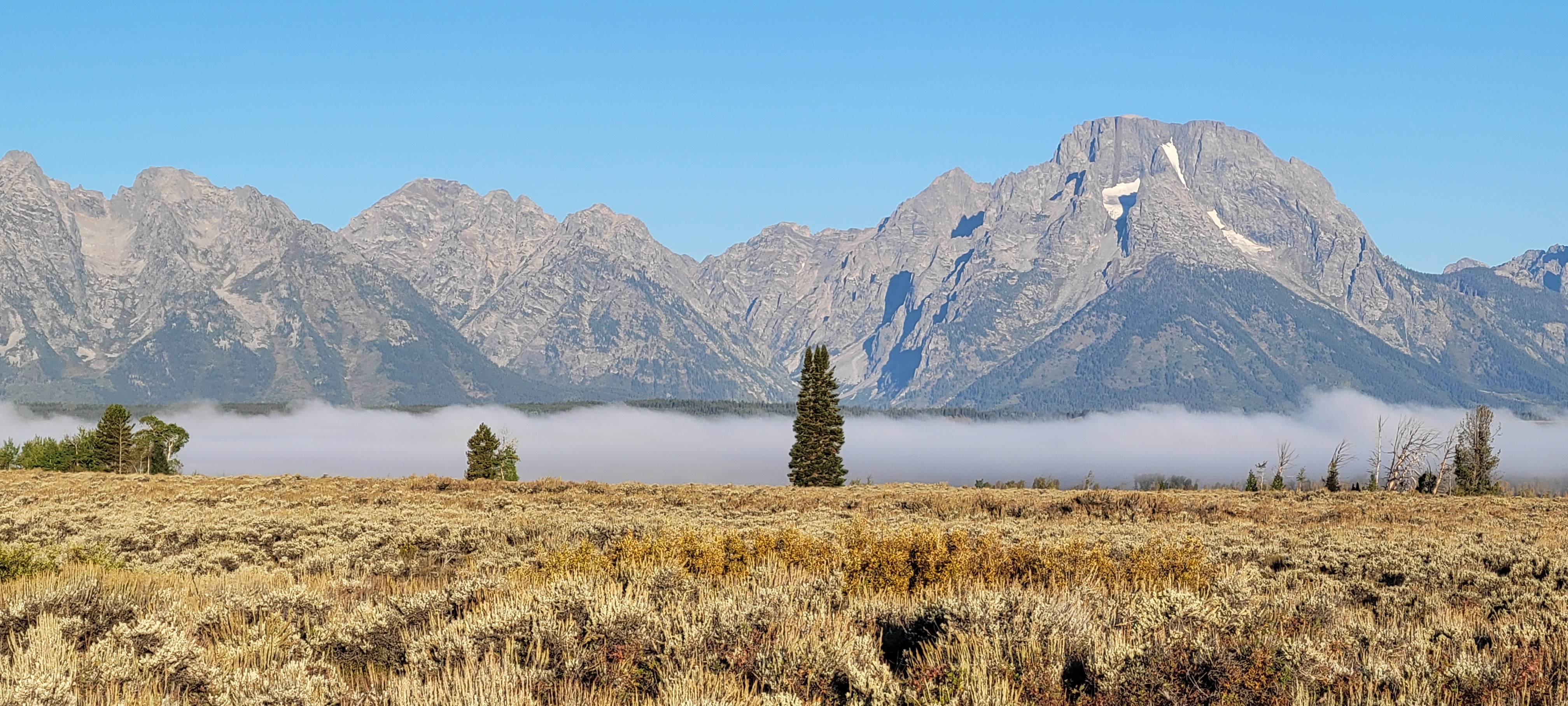
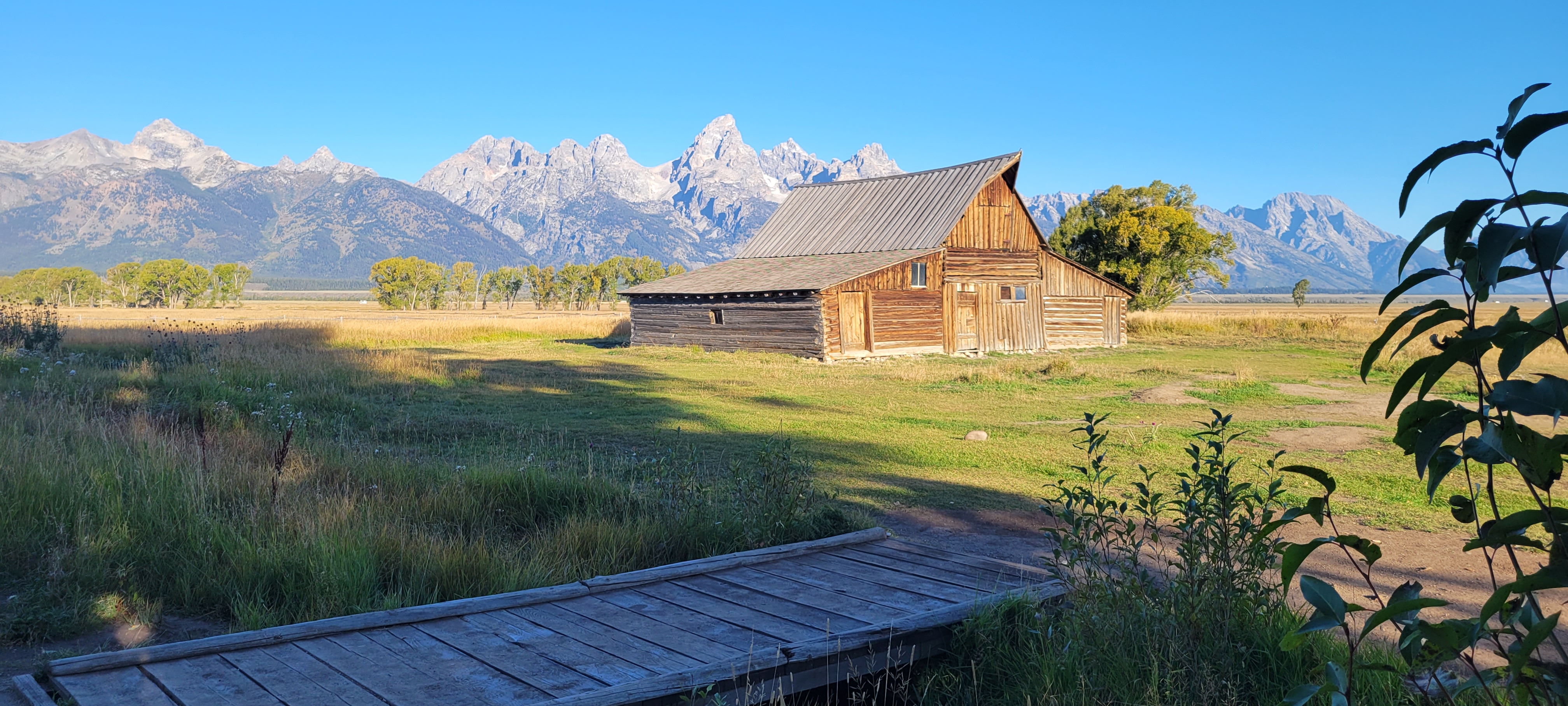
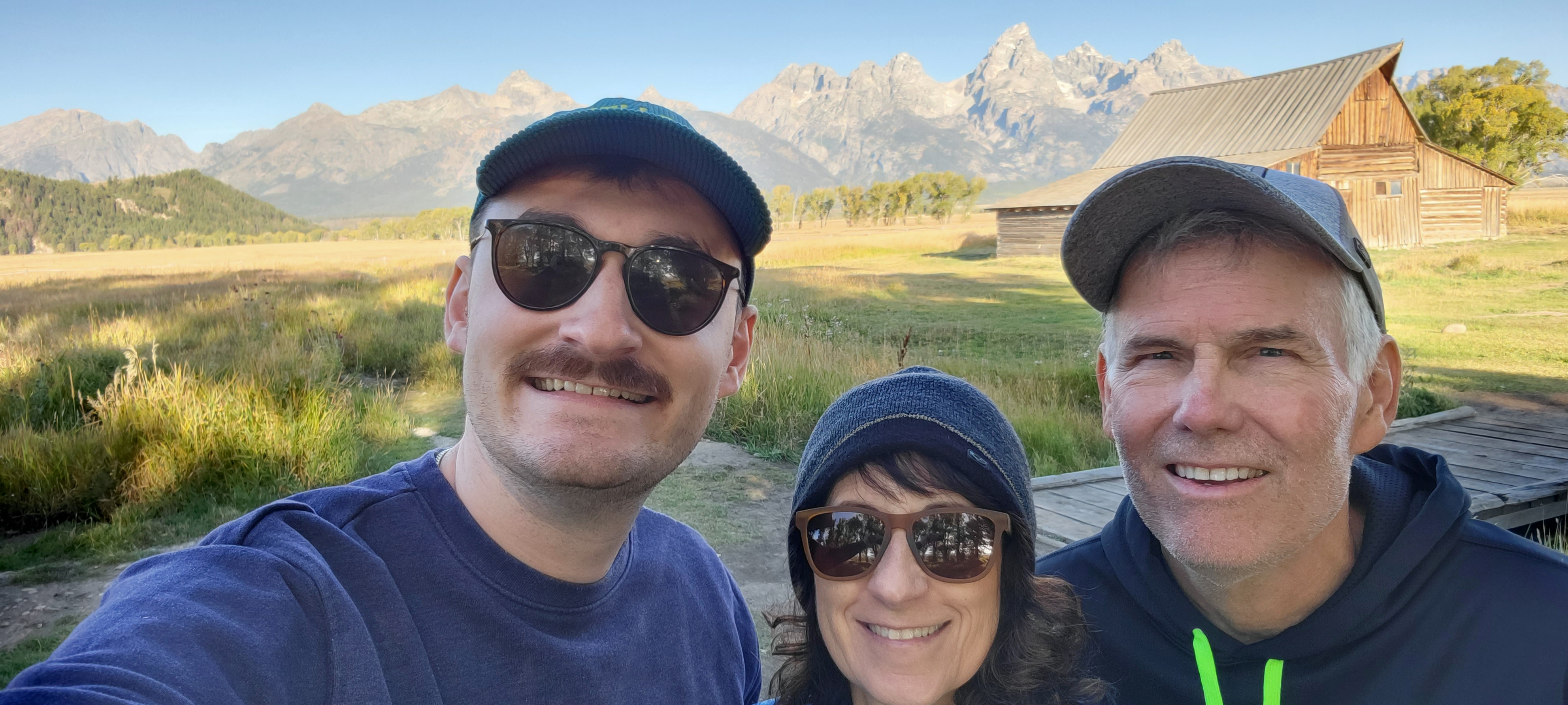
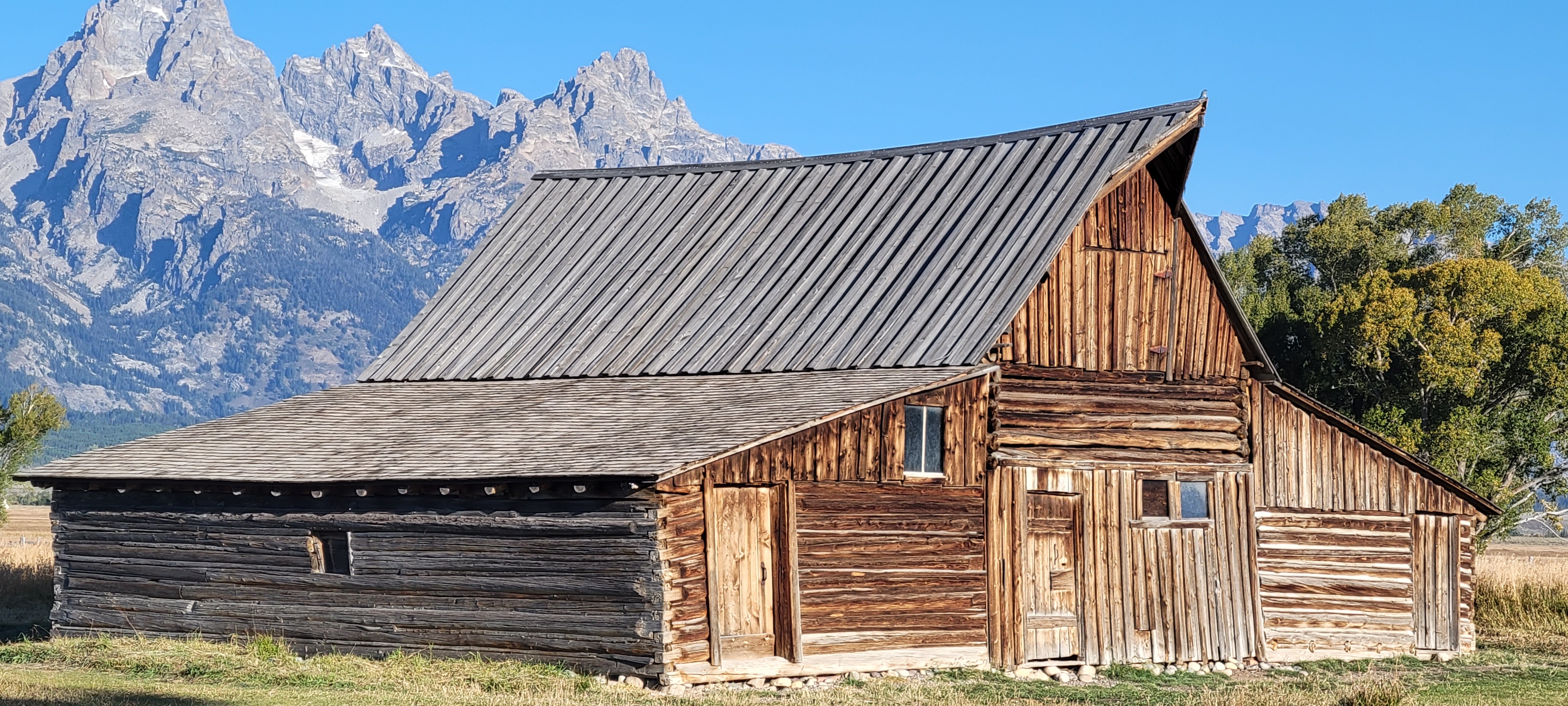
Grand Teton National Park lies just south of Yellowstone, down the John D. Rockefeller Jr. Memorial Parkway. The Tetons provide a ridiculously photogenic backdrop*** for even the most amateur of smartphone-toting photogs. That majesty atoned for our one night in a Colter Bay Village cabin*, a joint that in some ways made our Yellowstone digs seem like a penthouse. Colter Bay Village itself was more summertime Ozarks than something with such an awesome setting. And the accommodations? Mice, I can understand. But bats*?
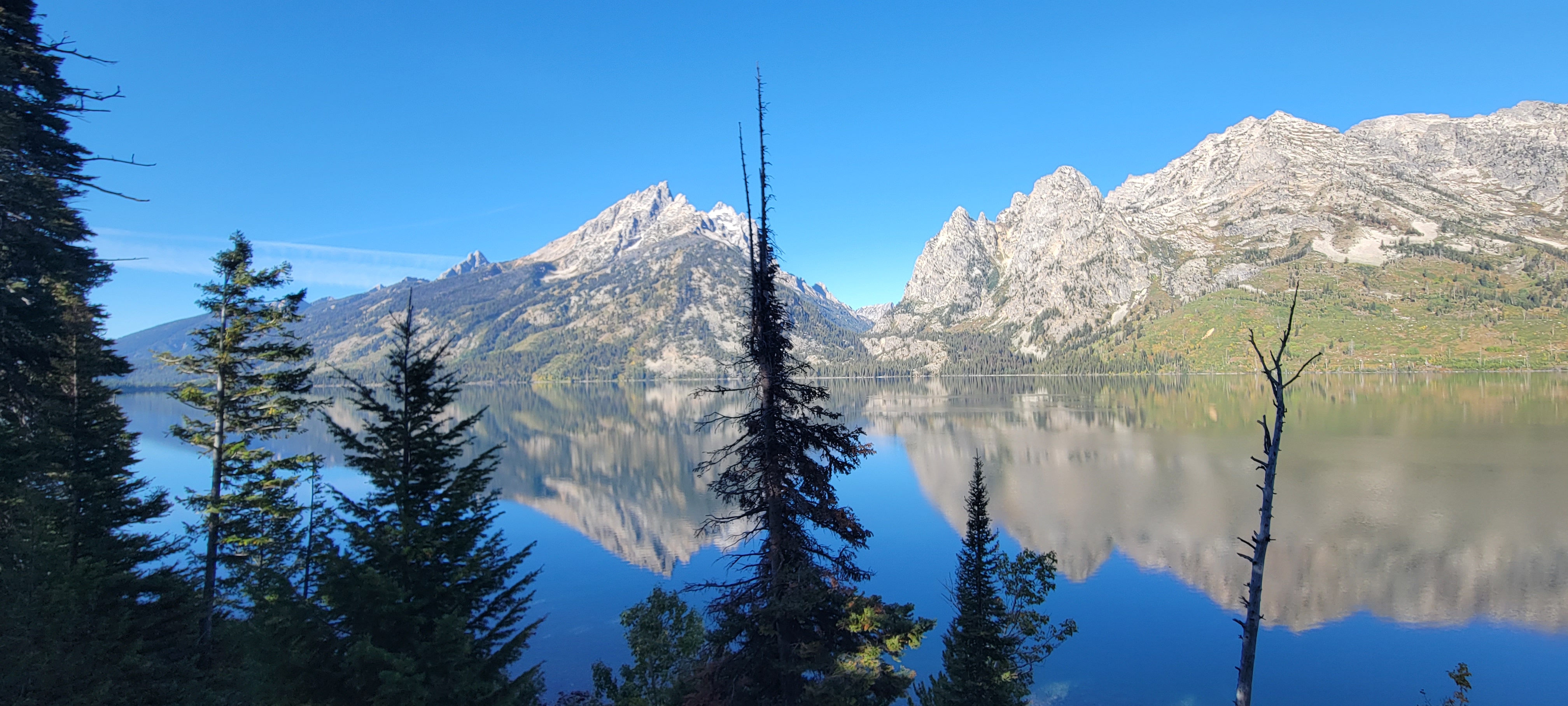
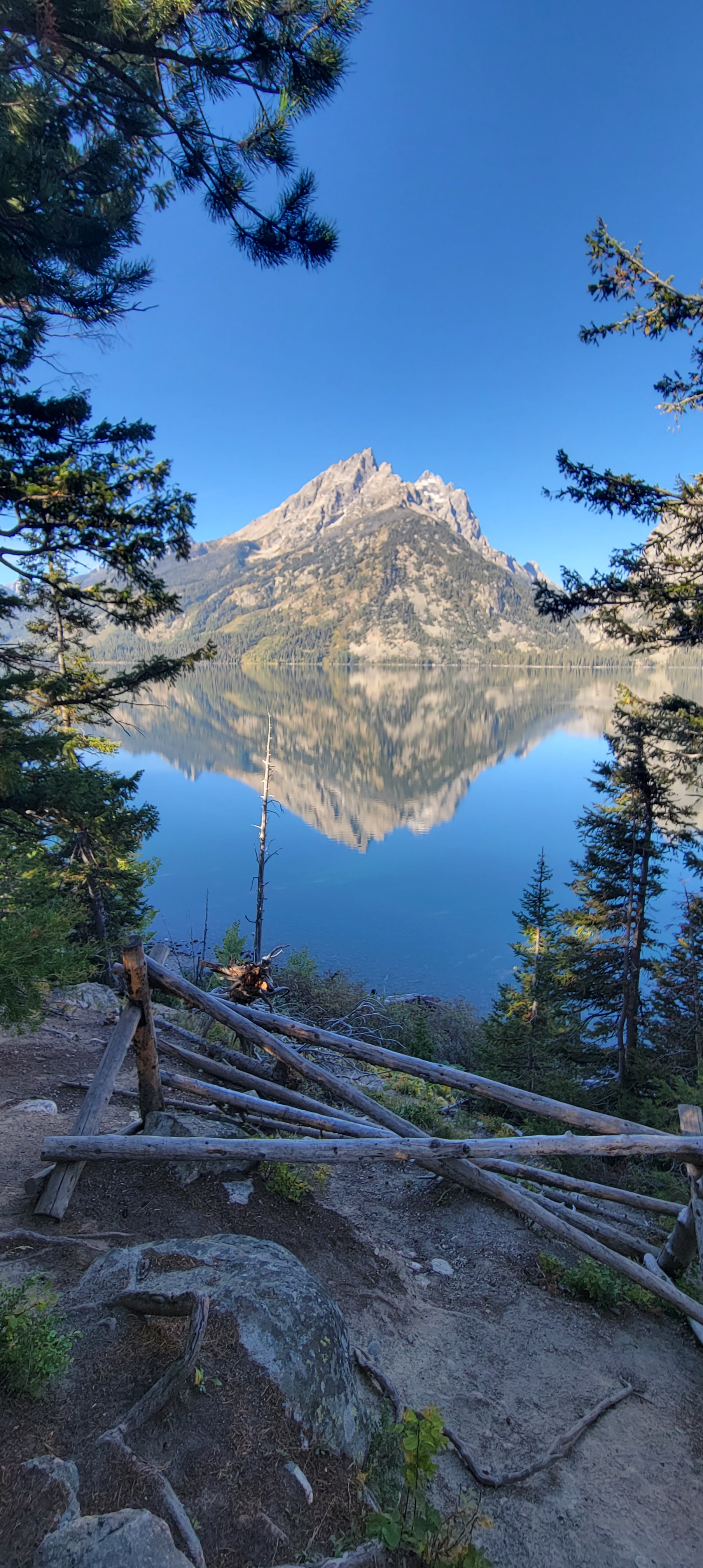
Still, worth it. Again, we found an off-the-path one-way road that is a hot spot in the summer but was uncrowded while we were there. Up to an overlook of Jenny Lake*. Stunning.
We had only about a day-and-a-half in Grand Teton — not nearly enough time — before we had to make our way back toward a night in Idaho (and a much-needed Marriott shower), and a final early morning drive along the winding, picturesque, we-should-stop-several-places Gallatin River to the airport in Bozeman.
—**—
I’ve said it many times before, and I’ll say it as long as I can: These little sorties into nature — outside the trappings of cities and suburbia and small towns and, I don’t know, of people — are important. They’re critical. For the quiet and the majesty. For the pure wonder. For your sanity. For your soul.
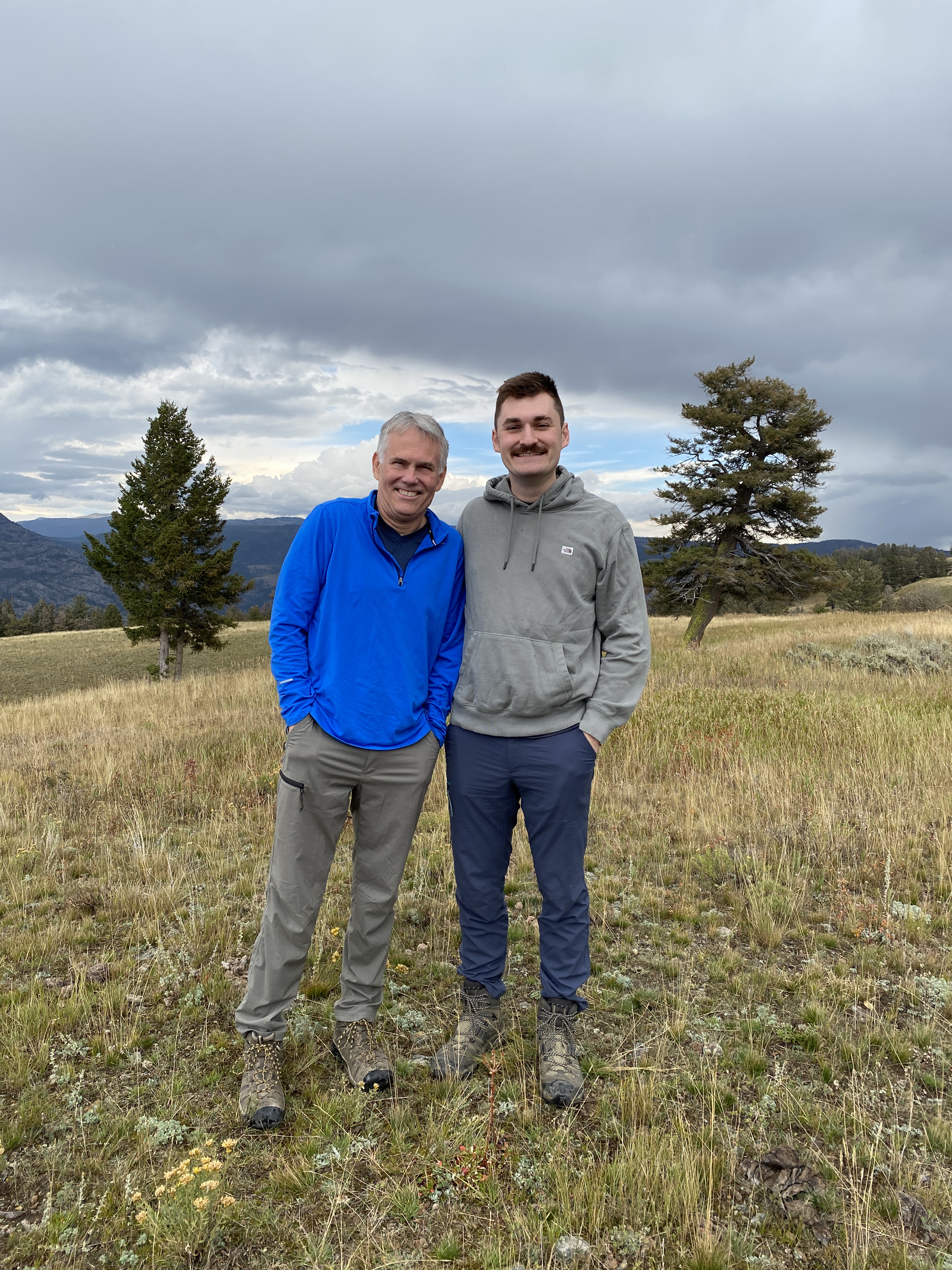
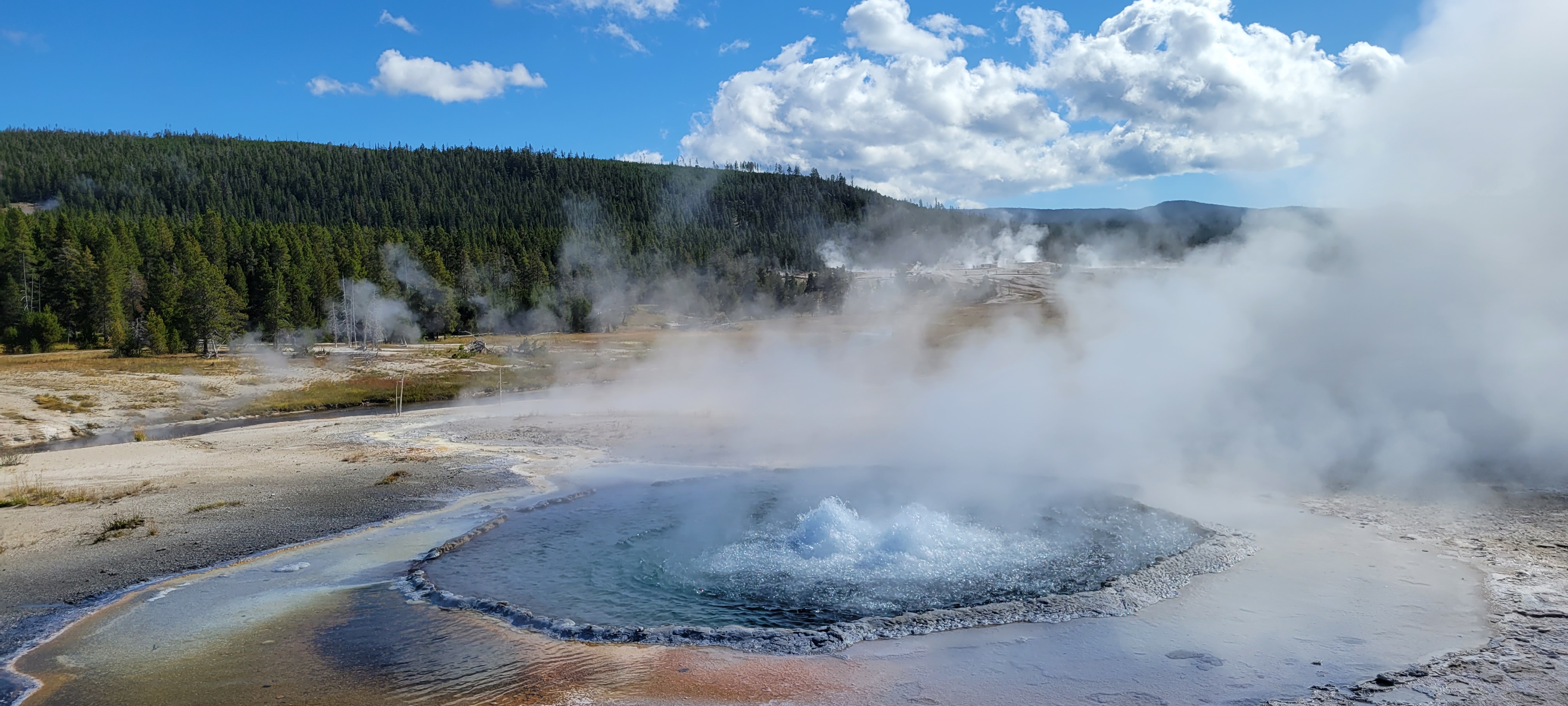
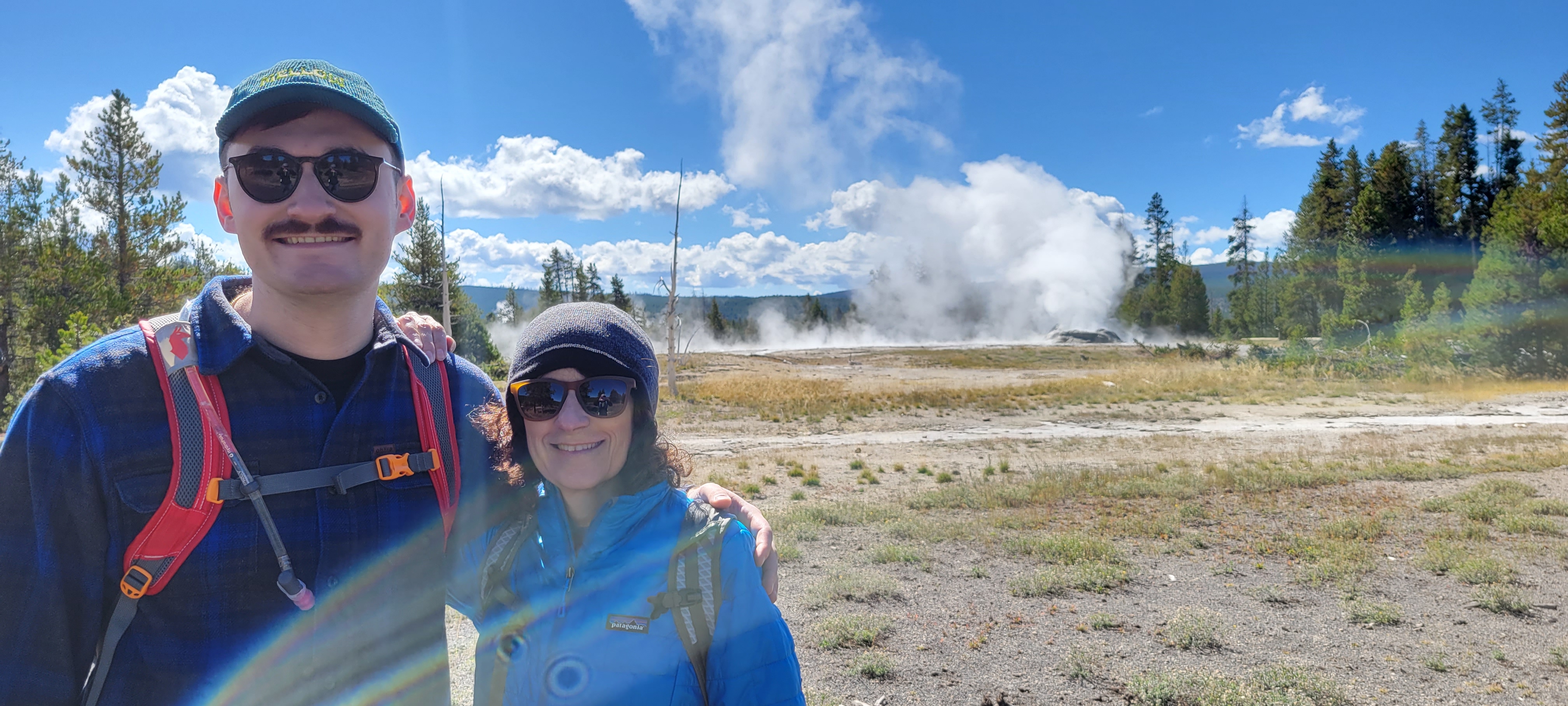
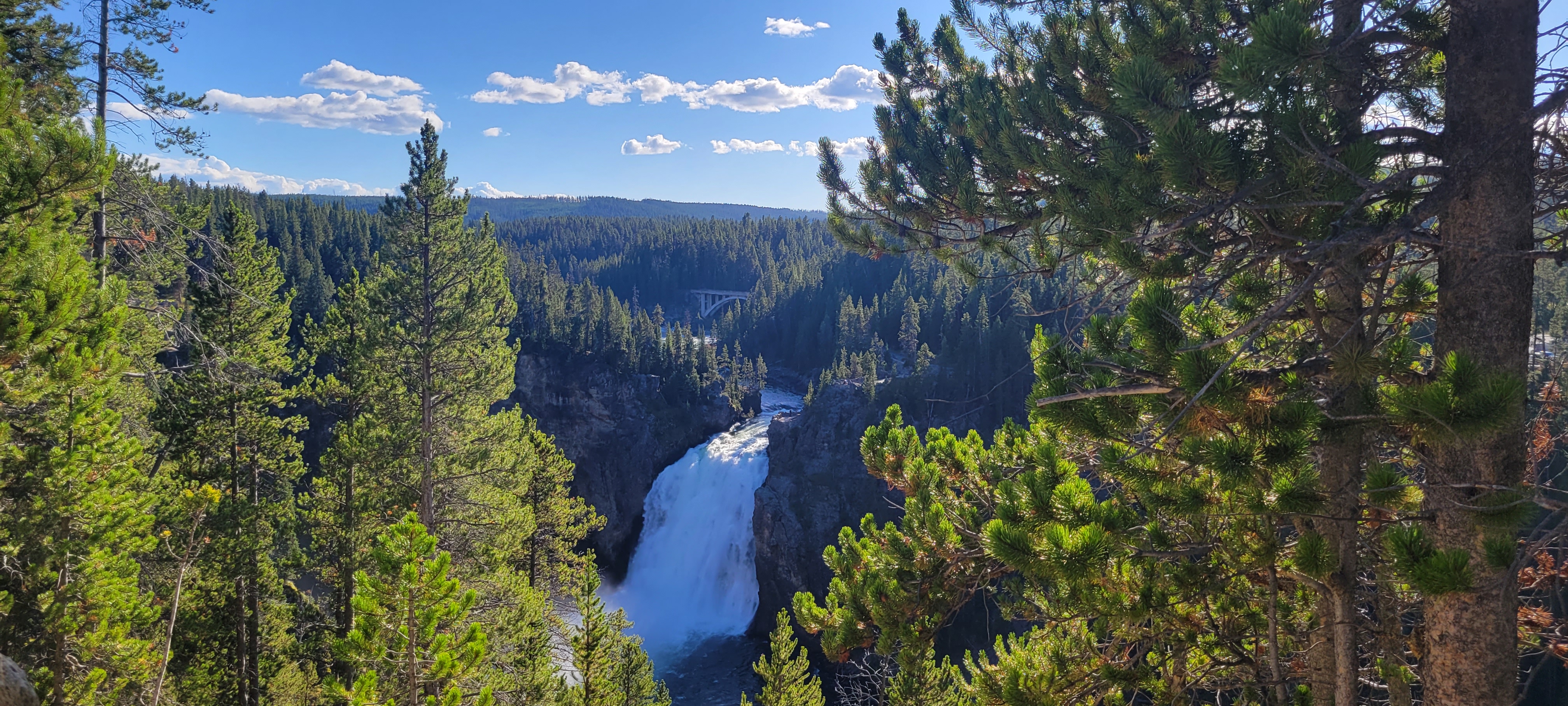
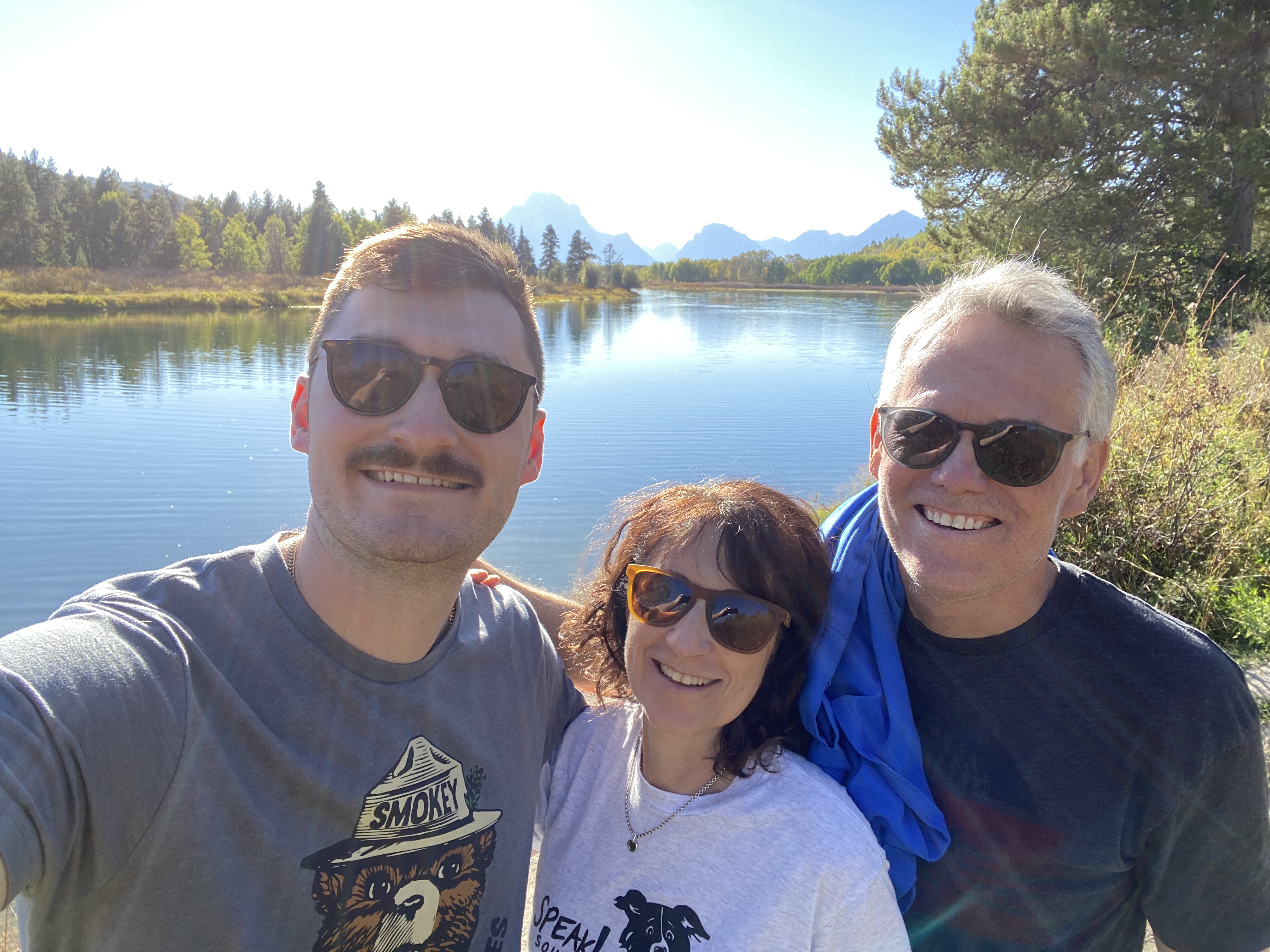
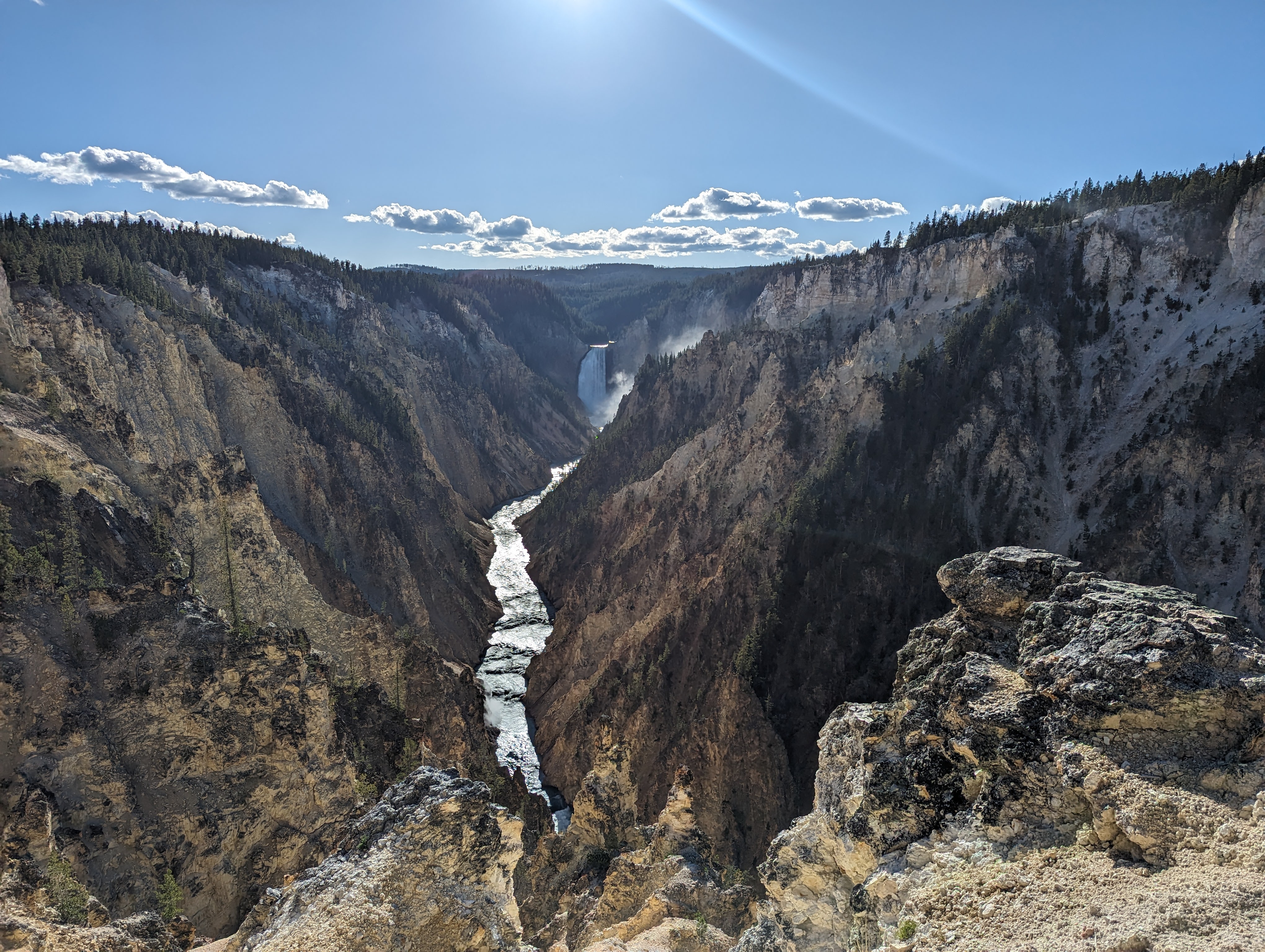
Whatever higher power you believe in, you’ll believe in it more as you drink in these places, away from traffic and work and noise and TV and the internet. And if you don’t believe in something more, something higher … check out the falls at the Grand Canyon of the Yellowstone*. Breathe in the air in the Tetons*. Peer into the clear, impossibly colorful depths of natural hot springs*. Take your loved ones*. Take it slowly. You’ll start to believe in something.
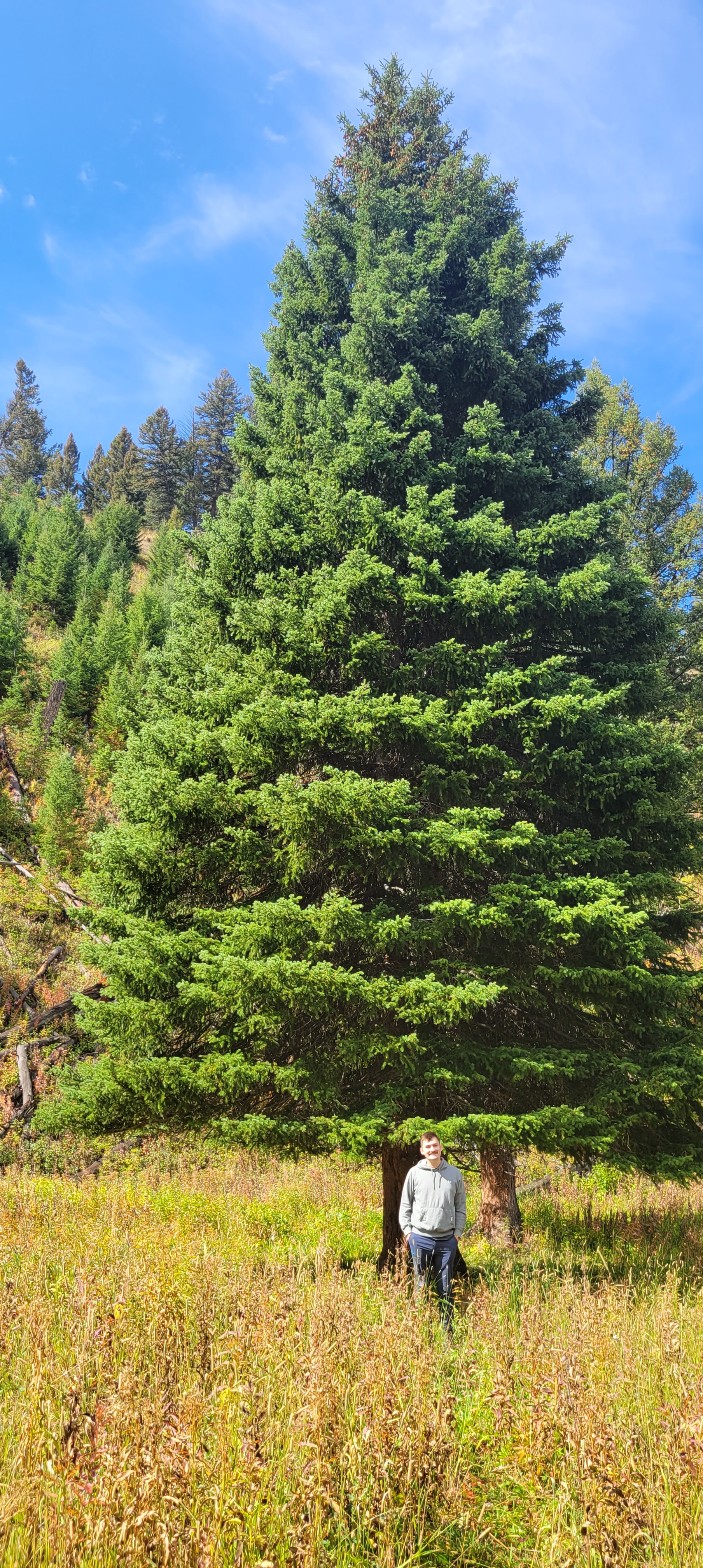
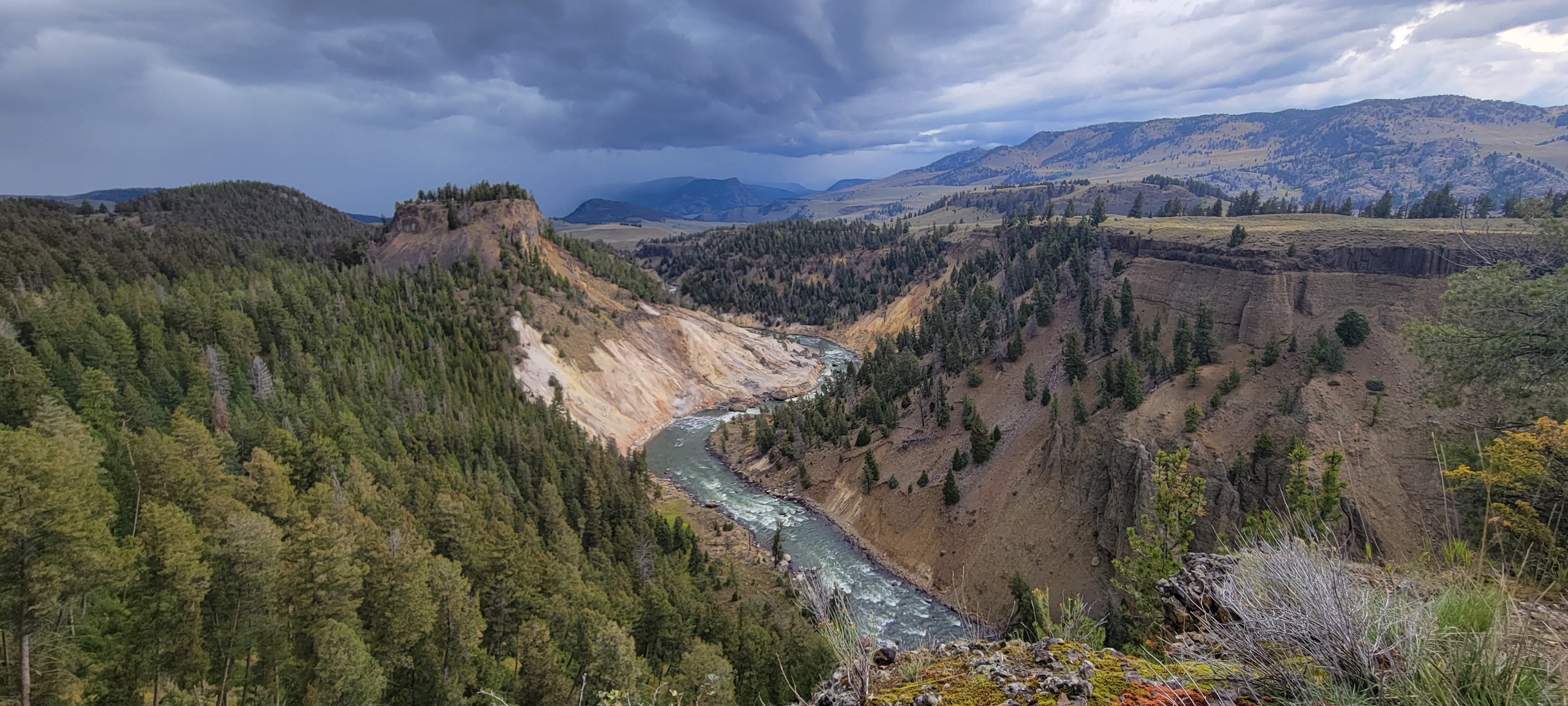
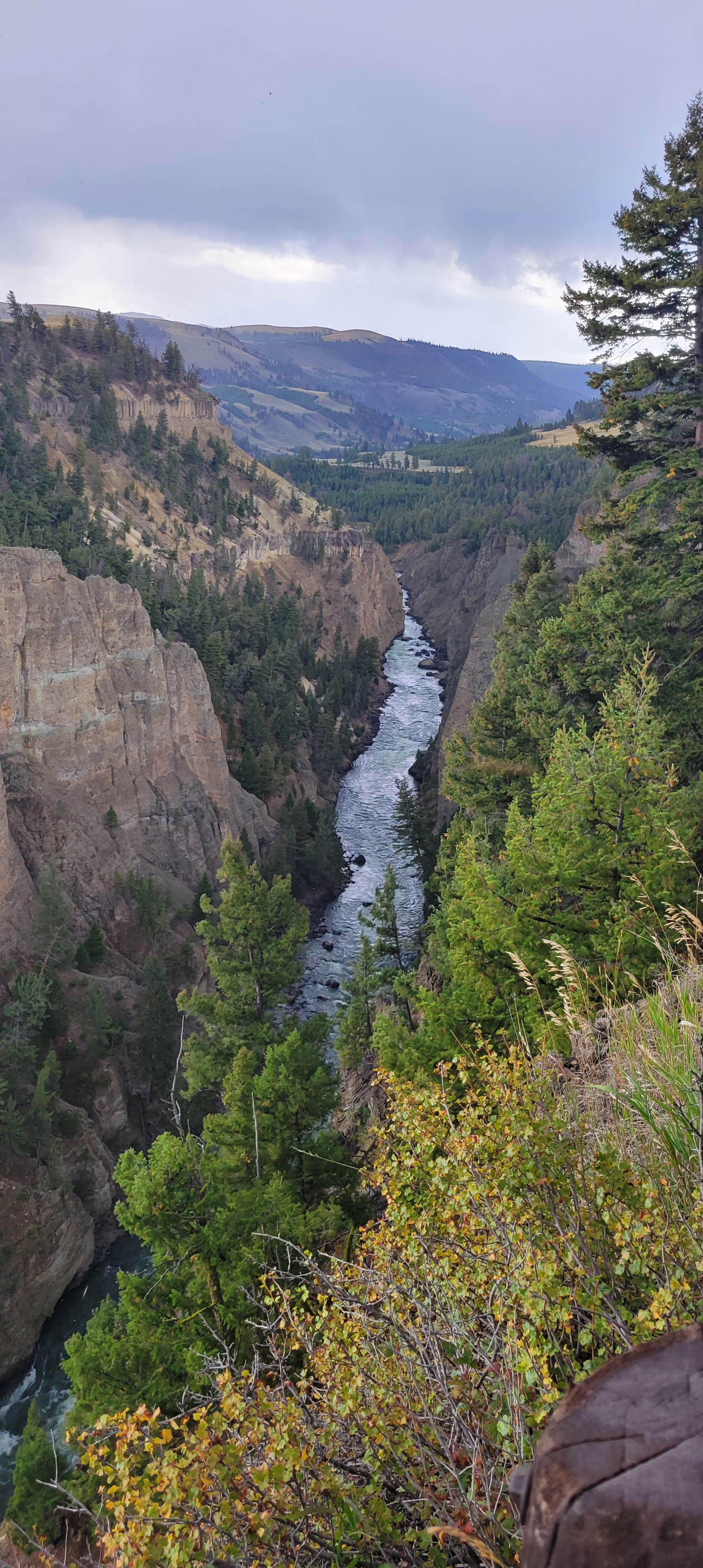
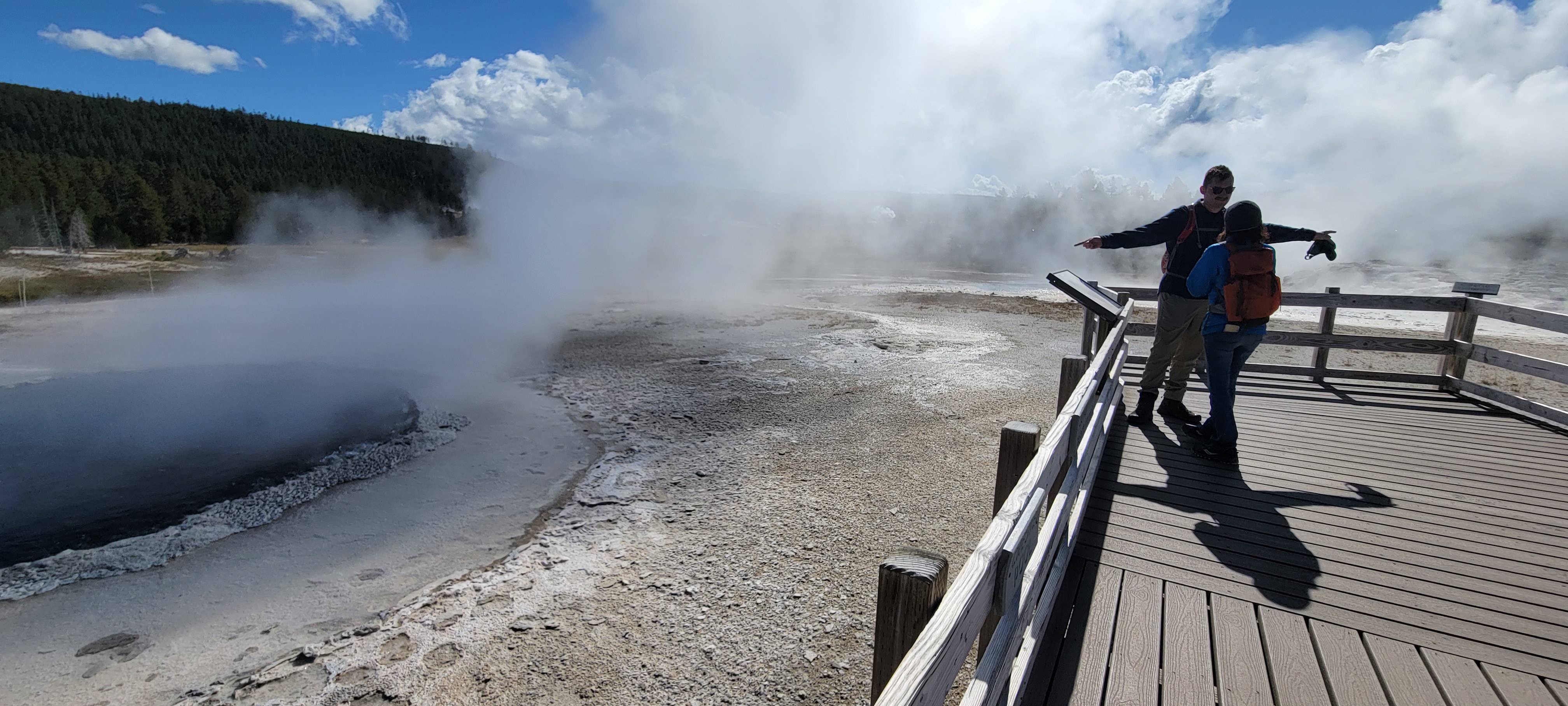
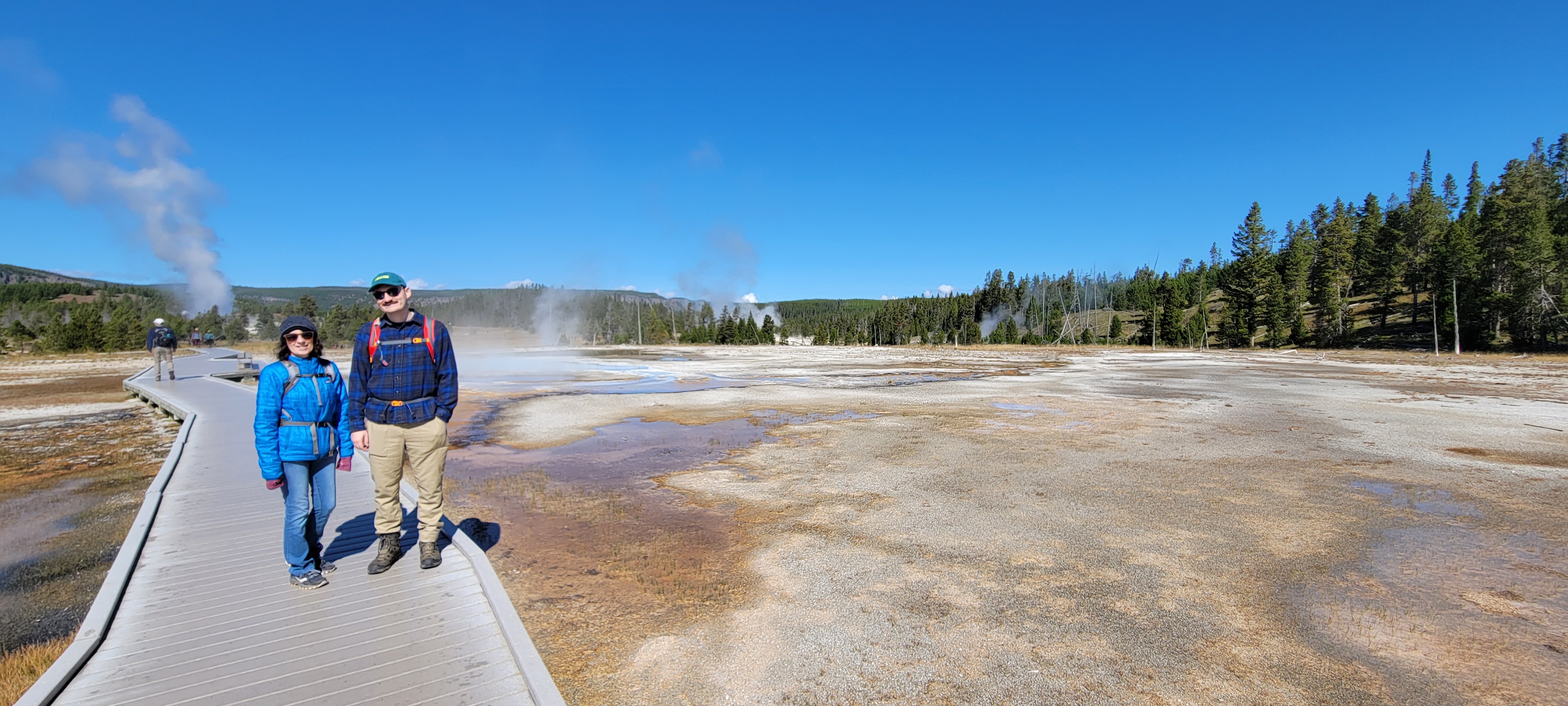
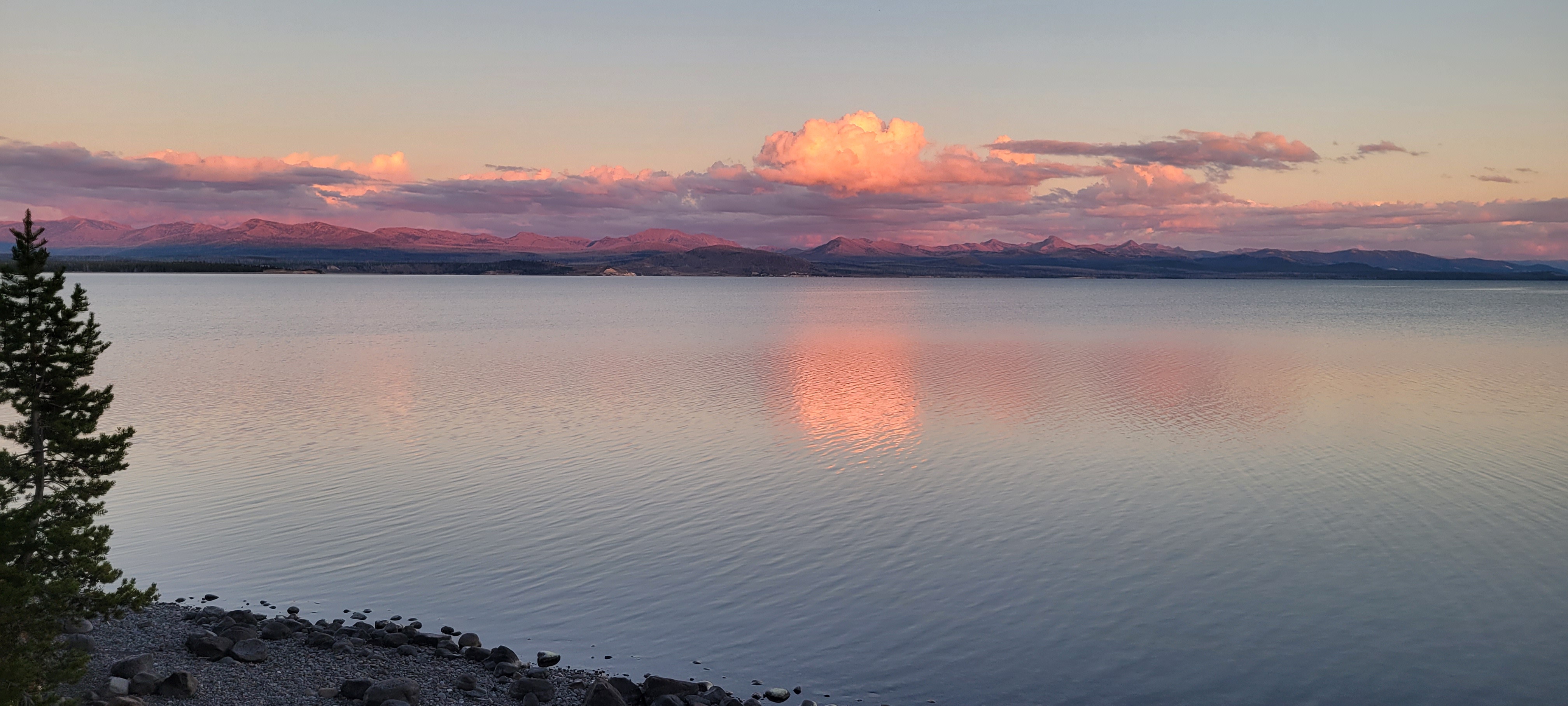
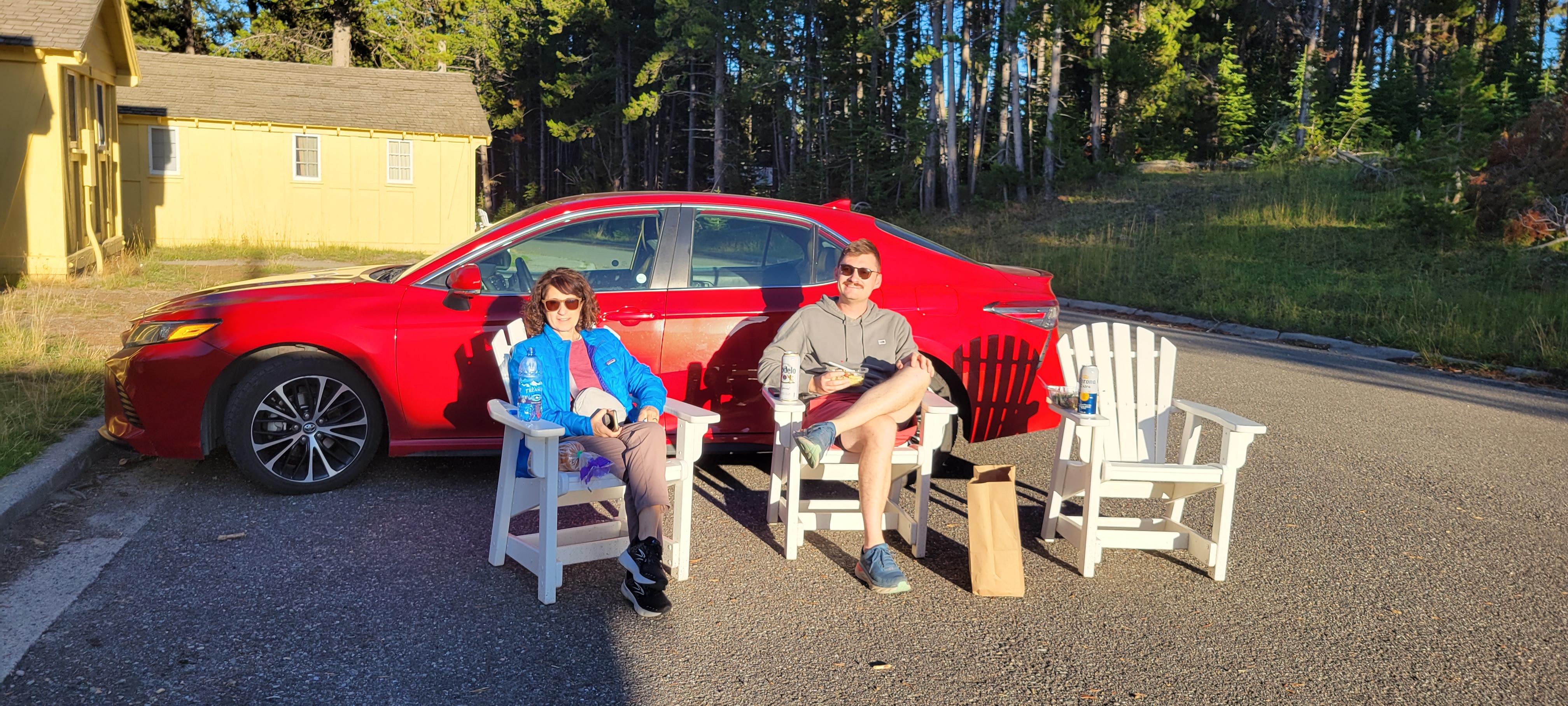
And, sure, take a picture or two while you’re at it. These are ours. About 1/10th of them, anyway.
Click on any for a full view and a caption.











 JD Blogs