
Here’s something that we all can agree on in these depressingly divided days: the idea of America.
Despite all that bad blood between us, despite the people on the other side of the political divide being the absolute worst of the worst, we can all agree — we do agree, in fact, both Democrats and Republicans, as many polls point out — with the ideas, the beliefs, the audacious spirit that a bunch of old white dudes so eloquently summed up almost a quarter of a millennium ago.
You know. Things like “all men [think people, if you would, just to avoid any arguments before we even get started] are created equal.” Freedom of speech. Freedom of assembly. The freedom to worship what you want, how you want. The right to bear arms. The ideas, some enumerated and others simply understood, that all Americans should be free to seek “Life, Liberty and the pursuit of Happiness.” Americans, overwhelmingly, of both parties, still buy into all that.
(A quick point on the Second Amendment: The Democrats’ current presidential candidate has let slip — she’s said it before — that she owns a gun and “if somebody breaks into my house, they’re getting shot.” The Democratic Party’s vice presidential candidate is a hunter. That demonstrates a truth that has long been distorted by Republicans. So to set things straight: Democrats don’t want to take away your guns. They never have, really. They may be after some of them. For sure, some want your assault rifles. They absolutely want to have a say in who gets to own guns, just so the nutbags out there are neutered a bit. But here’s the thing: Most Americans — everybody, Ds and Rs included — agree that something needs to be done to address the wildly out-of-control gun culture in the U.S. Six in 10 Americans believe we should have stricter gun laws. That, in political terms, is a consensus.)
(Yes, to keep this rolling along, Republican stances are distorted by Democrats, too, all the time. It’s politics. We know. That gun one, though, has lingered for all too long. It’s bugged me for awhile.)
Amazingly (again, given the vibe out there right now), Americans agree on a wide range of governmental policies. A sizeable majority of us agree — though you might not realize it considering all the grief the Affordable Care Act (aka Obamacare) has endured since its passage in 2010 — that people should have access to high-quality health care, according to the American Aspirations Index, run by the nonpartisan think tank Populace. According to a YouGov poll, most Americans think the government should even expand subsidized health care.
In both the YouGov poll and the American Aspirations Index, by the way, when respondents are given a list of issues that face us and asked to rank their importance, the need for better health care is the top area of agreement among Americans. I’m not sure I would have guessed that.
Another something we can agree on: Among both Democrats and Republicans, a wide majority of us agree that Social Security should be left alone. Some 66 percent of Americans (!!), according to a YouGov poll, say it’s very important, and of those, 73 percent (!!!) think Social Security benefits should be increased.
Despite all the apparent bickering over climate change (hoax or not?), a huge percentage of both Democrats and Republicans also say climate change and preserving clean air, water, and open spaces are among their very top priorities, according to the American Aspirations Index.
There are a lot of other areas of agreement, too; that people should be treated equally under the law, that public leaders should be held accountable, that our neighborhoods and communities should be safe, that our criminal justice system should operate without bias, that our borders are secure, that the middle class is thriving. Surveys, a lot of them, show that these things are very important to the whopping, undeniable majority of Americans.
And those are just a few of the issues that bind us.
****
Why, then, do we remain so divided? Exceptionally divided, according to another Pew Research study. Why do Republicans and Democrats so hate each other? Why do we all have such a bad taste in our mouths? Why is the election, just a month away now, such a source of angst and reflux?
One argument, a compelling one, is this: The problem is the political system itself. When it’s us vs. them, Rs vs. Ds, progressives vs. conservatives, leftists vs. rightists, this or that and only this or that, every hour of every day (of every decade), constantly amplified and distorted by sources inside and outside of the parties, many of which have their own agenda to push, things get nasty. And somebody has to lose.
Here’s a summation of the argument, from the Pew study linked two paragraphs up (^):
America’s relatively rigid, two-party electoral system stands apart [from others in the world] by collapsing a wide range of legitimate social and political debates into a singular battle line that can make our differences appear even larger than they may actually be. And when the balance of support for these political parties is close enough for either to gain near-term electoral advantage – as it has in the U.S. for more than a quarter century – the competition becomes cutthroat and politics begins to feel zero-sum, where one side’s gain is inherently the other’s loss.
The two-party system is one problem. Another one may well be the people who wrestle within those parties for power.
“Part of it is really our leaders are not reflecting the electorate, and they behave in a way that’s much more polarized than what the electorate is,” Lilliana Mason, a political scientist at Johns Hopkins University, told the Associated Press. Most Americans, she said, “are pretty moderate, but they’ve been riled up to hate people of the other party for being different from them culturally, racially and religiously.”
****
Clearly, many of the differences among us, and between our political parties, boil down to the how of things. How to fix our problems. How to bring the promise of America, the one those old white dudes conjured up so many years ago, to the most people possible.
Democrats and Republicans have different ideas. Understood. We often think the other’s ideas are for crap. We get that, too.
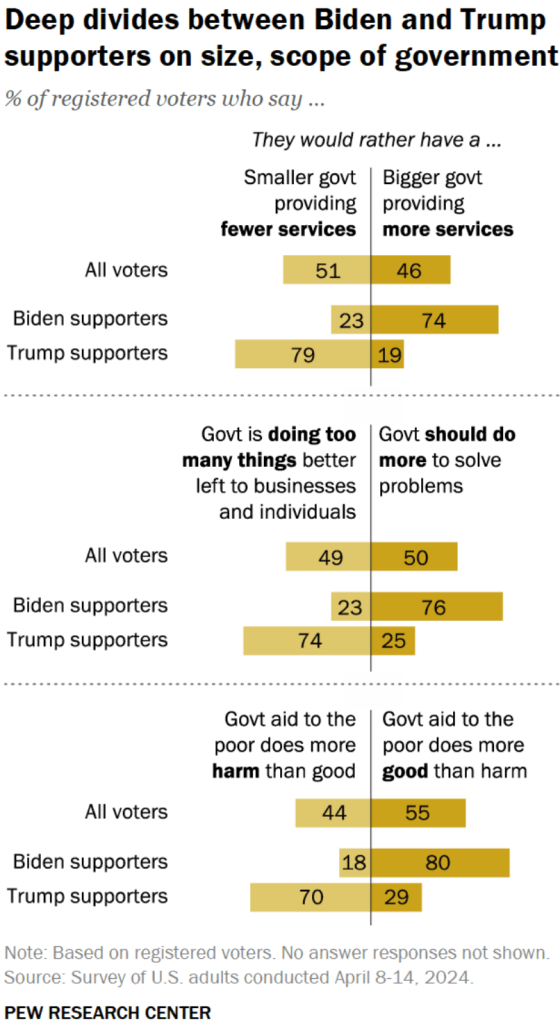
One general point of disagreement, and it’s a big one, is the role of government in our lives. Generally, Democrats think there is a role for the government. Republicans, not so much. (>).
It gets a lot more complicated than that, obviously. Clearly, the government has to have a role in some things. But Republicans have long been the party of smaller government/more personal responsibility/privatization if possible. That position goes back a long way, even before Ronald Reagan so famously said, “The nine most terrifying words in the English language are: I’m from the Government, and I’m here to help.”
Counterpoint: “If a free society cannot help the many who are poor, it cannot save the few who are rich.” That’s John F. Kennedy in his inaugural address in 1961.
Whatever the differences in opinion and approach, concentrating on those differences, amplifying them, distorting them, outright lying about them — which, let’s face it, politicians love to do; it perpetuates the us vs. them two-party slugfest — keeps us from tackling that very long, very important list of shared concerns. Populace, in their American Aspirations Index, puts it this way:
The bottom line: What is often mistaken for breadth of political disagreement is actually narrow — if extremely intense — disagreement on a limited number of partisan issues.
A word on immigration: It continues to be the thorniest and most divisive of issues that separates Americans. It has been for some time.
The point is, though, we agree on so, so much more …
- Our individual rights should not be abused.
- Everybody should have access to decent, affordable health care. It’s a necessity, not a privilege.
- Inflation, at least in this election cycle, is on voters’ minds; we need to get it under control.
- We should address climate change, and preserve our clean air, water, and open spaces for future generations.
- We need to shore up Social Security, and maybe even increase benefits, so we can all retire in dignity.
- Our public officials need to be held accountable for their actions.
- Most Americans report that taxes are a “very important” issue. Among those, both a majority of Democrats and Republicans think we should increase taxes on the wealthy.
- A majority of Americans, according to a YouGov poll, who say that education is a very important issue think that we should increase funding for public schools.
- We need to tighten laws on who can own guns.
- We need to crack down on crime and make our country safer.
That’s a short list, just for starters, of what Americans want. It’s overwhelmingly what we agree on, both Democrats and Republicans.
In a month or so, we’ll make a choice for president. Column A, or Column B. Democrat or Republican. Kamala Harris or Donald Trump. Either or.
Who’s going to figure out the how, somehow bring the warring sides together, and finally get things done that Americans want done?
Can anyone?
[Next: The choice.]
 JD Blogs