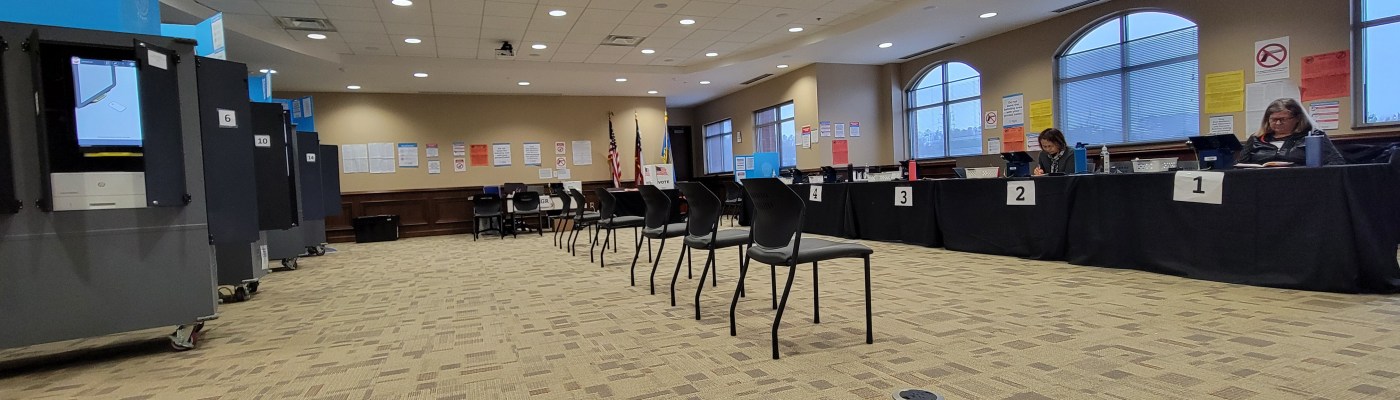
The whole idea behind volunteering in the first place was to give a little something back, to provide what I figured is a much-needed civic service, to get a grasp of a teensy piece of the inner workings of this clearly not always smooth-working democracy of ours. It’d be a learning experience, this volunteering thing, I told myself. Or, at least, an experience. That was the whole idea.
I’m not sure that I actually pulled off all of that. I’m not sure, after nearly three weeks as a clerk working for Fulton County during the early voting period of Georgia’s Presidential Preference Primary — numbingly long, painfully boring, frustratingly unproductive days, every damn one of them — that the whole experience was worth all the time and effort.
But, yeah. It was an experience ….
To vote in America in the early 21st century, to perform the most basic of civic responsibilities, is a tiptoe through a field strewn with piles and piles of political and social dog poop. It’s not just who you vote for these days, of course. It’s how you vote; how you physically and/or figuratively check off a box and physically and/or figuratively slip your choices into a real or cyber ballot box to be counted however votes are counted these days. The process, different from county to county and state to state, seems almost comically overcomplicated.
In Georgia, in Fulton County, for this particular primary, this is how it worked: (And if you think this play-by-play tends toward the tortured, try clerking for the better part of nearly three straight weeks.)
** Voter comes to the polls and steps into the controlled voting area. Dozens and dozens of signs — more than 100, closer to 150; I counted them — paper the walls and the voting booths. They warn about the use of cellphones (not allowed), of carrying weapons in a polling place (there’s no federal law against it, but even in gun-happy Georgia, polling places are gun-free), of helping someone in a neighboring voting booth (also not allowed, even if it’s your spouse, unless s/he agrees, in writing, to be assisted). The signs list Georgia voting laws, chapter and verse. Posters lay out the steps to voting. They suggest what to do if things go wrong; say, you change your mind after you’ve already voted, or you’ve gone to the wrong polling place. Signs are everywhere, inside and outside. No one reads any of them.
** Voter is ushered to a clerk (me) and presents a government-issued photo ID. A Georgia driver’s license is standard here, but it could be (for early voting in this election), perhaps strangely, a driver’s license from any state, as long as the voter is registered to vote in Fulton County. Could be a military ID. Could be a Georgia Tech student ID. Could be an ID from the City of Roswell’s Recreation, Parks, Historic and Cultural Affairs Department. The ID could be, in some cases, expired. It may have a birthdate on it. Or not. The photo may look startlingly unlike the person who is presenting it (which, in my experience, is just a standard driver’s license photo). Doesn’t matter. Just so it’s a government-issued photo ID.
** The would-be voter steps up as the clerk (me again) makes a few taps on an iPad-looking tablet (called a Poll Pad) to try to match that ID — and the person attached to it — with a person in the Fulton County voter registration rolls. If the wannabe voter is, indeed, registered to vote and the information on file roughly matches the ID provided (the birthdate is the same, or the name, or the address) and that person is in the correct polling place, the voter e-signs on the screen declaring that s/he is the voter s/he says s/he is, and then selects a ballot. For this election, the voter could pick only one ballot. Either ballot.
** After that, the clerk (moi) sticks a plastic card into the Poll Pad to encode it with the voter’s information, then the voter is handed the card, pointed to a different computer screen called a Ballot Marking Device, or BMD (clever, these professional election specialists), where s/he inserts the card. The chosen ballot pops up on the screen (at left in the photo above ^), and the voter does democracy. After the choice is made, the screen prompts the voter to print out an actual, physical, paper ballot. That ballot is taken to a scanner, where the vote is tabulated electronically. The paper ballot is fed into a big bin to be collected later.
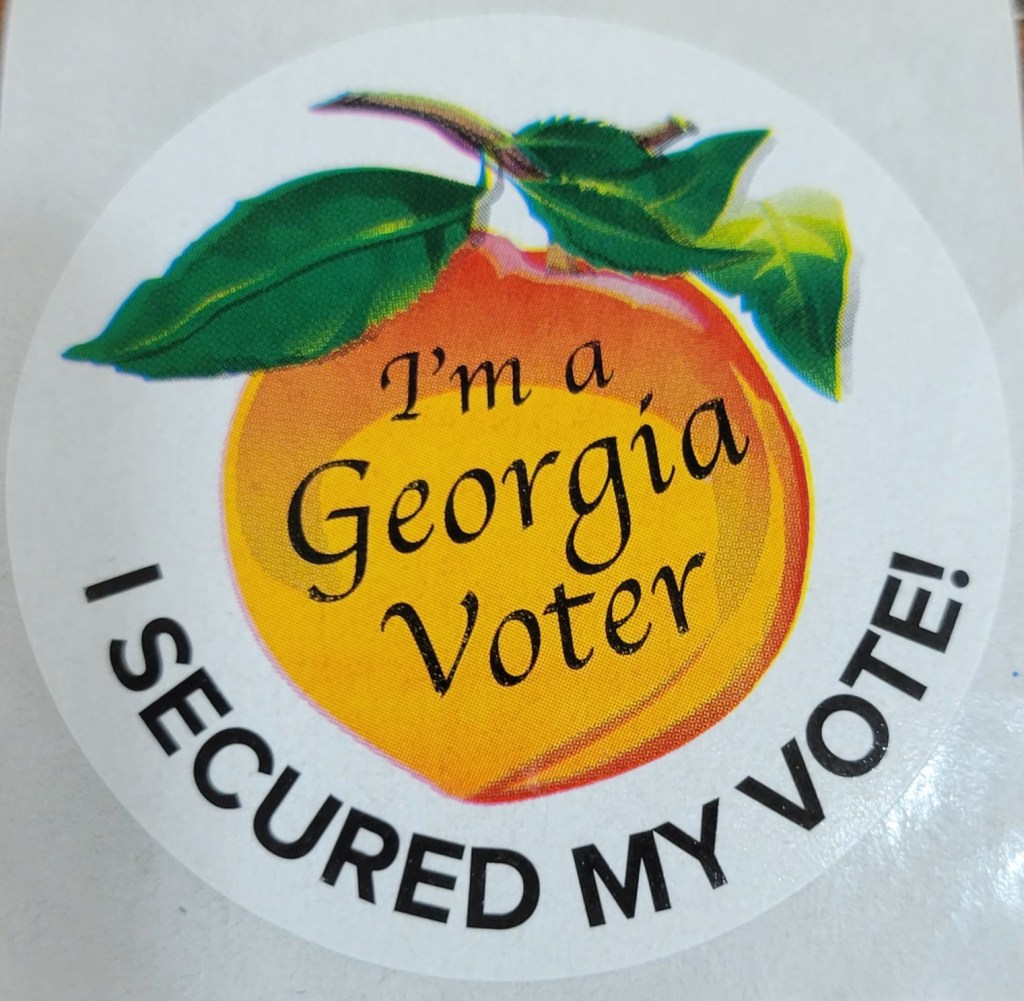
Get your “I Voted” sticker. Move on. That’s it.
In today’s hyper-politicized world, it shouldn’t be surprising that every step in the process is under withering scrutiny and extreme security. Every Poll Pad, every BMD, every cabinet and box that holds those devices, every place a paper ballot is scanned or is held — all of them — are bound with a seal (basically a zip-tie with a unique number on it) that is recorded and entered into daily records. The counts for each machine are taken hourly. Each Poll Pad prints out a slip for each voter. Those are gathered and sealed. All the paperwork is sealed up.
And that’s the way it has to be because people are watching. Poll watchers, observers, and activists are almost literally looking over the shoulders of the people running the polling places. All the time. Conspiracy-minded nutjobs, well-meaning voting groups, all of them are looking for even the slightest of slipups. Say, a line monitor falling asleep in a chair. A stray printout from a Poll Pad. A voter with a cellphone. A clerk with a cellphone. Clerks talking politics. Someone trying to slip away with a printed ballot. A confused voter being helped by someone else. Whispering at the booths. Numbers on the Poll Pads, the scanners, and the BMDs that don’t quite match up. The polls closing a minute early.
Just the hint of voting impropriety, as we’ve learned, can be crippling and potentially dangerous. Recounts, often mandated by the courts, are common. Hand-counting of ballots, sometimes thousands and thousands of ballots, is de regueur. Often, ballots are counted and re-counted several times. It’s just part of the process now. People’s rights — their basic, democratically guaranteed right to vote and for that vote to be counted — are on the line. Entire precincts, and the votes tabulated there, could be wiped clean by a judge agreeing that something was even slightly amiss. It’s intense.
Except when it’s not. Which, in this particular presidential primary, in this particular polling place, was almost all the time.
Besides that overwhelming, unrelenting, crushing urgency to get everything right, and the very real sense that people are constantly watching, then, what did I learn, what did I experience, in my time working the polls?
First, I learned that early voting for a presidential primary — which does nothing but determine who’s on the ballot for the general election; it really doesn’t settle anything — is not a priority in a lot of places. In Democratic-leaning Fulton, only 16,152 votes were cast for the winner on the Republican side. Only 43,342 were cast for the winning Democrat. That’s in a county of more than 1 million people, where somewhere around 750,000 are registered to vote. That’s roughly an 8 percent turnout. Not a priority.
During one five-hour shift, in the County building where I did my time, we processed a total of 17 voters. Our high for a day, most of them 10 hours long, was in the 40s. We had, at the minimum, eight people working each day. We never had more than three voters at once. Other places in the county, granted, were busier. Some even had lines. But I read four novels sitting behind the Poll Pads over those 15 days or so that I worked. Or, more accurately, I “worked.”
I also learned that it takes all kinds of people to run an election. I filled out a form to volunteer late in 2023 and soon found out that Fulton County was having none of that “volunteering” stuff. The County has learned that it can’t count on unpaid workers, even if they’re willingly unpaid, so all the people working the voting places — me included — were compensated. (If you must know, a clerk gets $17 an hour.) That, of course, brought out all sorts; young, old, in it for the money, in it because they had nothing else to do or could find nothing better, in it for the civic duty, and some who could care less about civics or responsibility. Some saw the long, slow, tedious days as the easiest money they ever made. Others thought it may have been the hardest.
In those people, though, came the best experience of my Fulton County time.
On one markedly slow afternoon, several of us sat in a circle behind our Poll Pads and talked. About cars and food, about our families and pasts. We weren’t supposed to be steering into politics, and we didn’t, mostly. But the conversation occasionally veered that way. A retired pilot next to me pushed for school vouchers and decried the crooks and military-looking young men pouring across the southern border. A middle-aged woman, who emigrated from China more than a decade ago, talked of the repressive Communist government there. A 40-year-old woman (we celebrated her birthday one long day) told us of crooked elections in her native Colombia.
An older Black man who grew up in Mississippi filled us in on the history of the Devil’s Punchbowl, a horrible Civil War-era episode I’d never heard of before. A middle-aged Black woman, a voting precinct veteran who works as a tax preparer in her spare time, talked passionately of the importance of the church in her life. A retired hospital administrator, a white woman married to a retired lawyer, did crossword puzzles and was learning to crochet. She and her husband lived with one of their kids, in a separate area with its own kitchen and bathroom. It was working out great.
A young Black man, maybe 22 years old, wrote in a journal his first few days on the job. An 81-year-old man who spoke five languages (including Italian, Spanish, and Arabic), a bicycling enthusiast, was busy writing a book on the Middle East. In the conversations among us, we touched on the homeless problem (“I just want to get where I’m going and not be hassled,” said the man from Mississippi), immigration (“I would never live there again,” said the Colombian woman), and voting. One of the Fulton County elections trainers who taught many of us in the room, in explaining what to expect, told us, “The poll watchers are not your friends.”
As I sat there in the dead-quiet voting space surrounded by a bunch of strangers brought together either by duty or dollars — maybe by both — it occurred to me that this little group, in that room, at that time, was probably as representative of America today as any random slice of the population.
We disagreed, sure. The quiet among us tried to keep it cool. The loud, being the loud, didn’t make nearly that effort. But we all found a way to step around the figurative poop piles and, more than simply working together, discovered how to get along. How to appreciate what we had. How to make the best of it.
That, after the polls closed and the voting apparatus and all the secreted ballots were loaded onto the trucks, was what I got out of the whole “volunteering” thing. That made the stupidly long hours, the achingly boring stretches, the constant unblinking eyes on us as we carried out this small and critical duty of democracy palatable.
In the end, it’s all about we the people, right?
 JD Blogs